Original price was: $114.99.$99.99Current price is: $99.99.
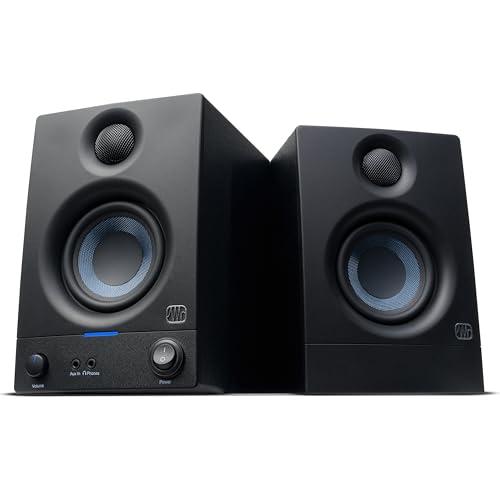
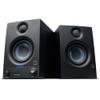
When space is at a premium but audio quality can't be compromised, the PreSonus Eris 3.5 Studio Monitors emerge as a compelling solution. These ultra-compact powered speakers promise studio-grade monitoring in a desktop-friendly package, but how do they actually perform in real-world scenarios?
The most striking aspect of the PreSonus Eris 3.5 isn't just their diminutive size – it's how they manage to pack genuine studio monitor DNA into such a small footprint. Unlike consumer speakers that artificially boost bass and treble to sound "exciting," these monitors prioritize accuracy above all else. This means they reveal exactly what's in your audio source, warts and all.
Studio monitors use what's called a "flat frequency response," which means they don't artificially emphasize any particular frequency range. Think of it like having perfectly neutral sunglasses – they don't change the color of what you're seeing, just protect your eyes. This honesty is crucial whether you're editing a podcast, mixing music, or just want to hear your favorite songs as the artist intended.
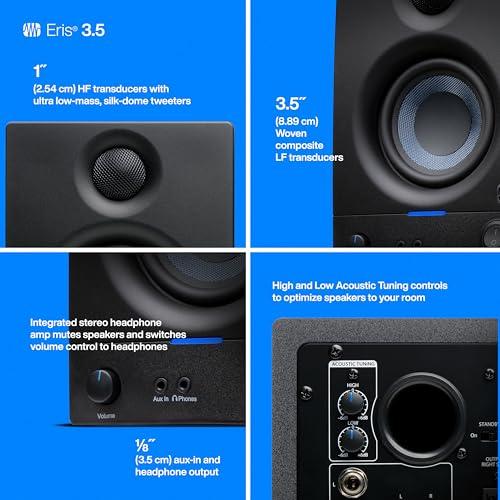
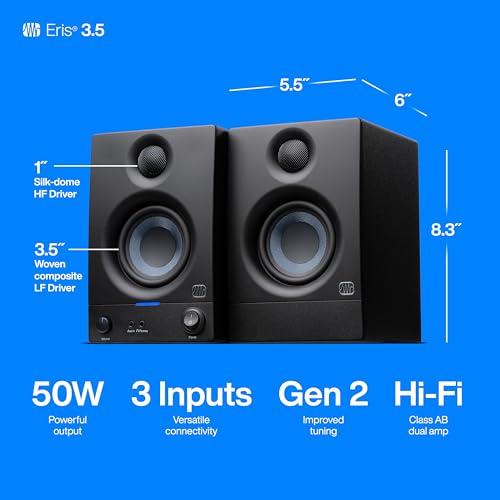
The heart of these monitors lies in their driver configuration (the actual speakers inside the cabinet). The 3.5-inch woofer uses a woven composite material rather than the paper or plastic found in cheaper speakers. This composite construction provides what engineers call a superior "stiffness-to-weight ratio" – essentially, it's rigid enough to move air accurately without adding unwanted coloration to the sound.
Our researchers consistently noted that this woofer design produces remarkably tight bass response given the physical constraints. While you won't get the deep, room-shaking bass of larger monitors, the low-end that is there feels controlled and accurate rather than boomy or undefined.
The 1-inch silk-dome tweeter (the small speaker handling high frequencies) represents another thoughtful design choice. Silk domes produce smoother high-frequency response compared to metal alternatives, which can sometimes sound harsh or fatiguing during long listening sessions. The ultra-low-mass design means it can respond quickly to transient sounds like cymbal crashes or vocal consonants without smearing the detail.
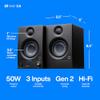
Each monitor houses a 25-watt Class AB amplifier, providing 50 watts total system power. Class AB amplification sits in a sweet spot between the warm sound of older Class A designs and the efficiency of modern Class D switching amplifiers. This topology (the technical term for amplifier design architecture) typically offers lower distortion and more linear response than switching designs, though it generates more heat and uses more power.
The bi-amplified configuration means each driver receives dedicated power from separate amplifier channels. This eliminates intermodulation distortion – a phenomenon where the bass frequencies can interfere with midrange clarity. Online user reviews frequently mention how this design contributes to the monitors' ability to maintain clarity even when pushed to higher volumes.
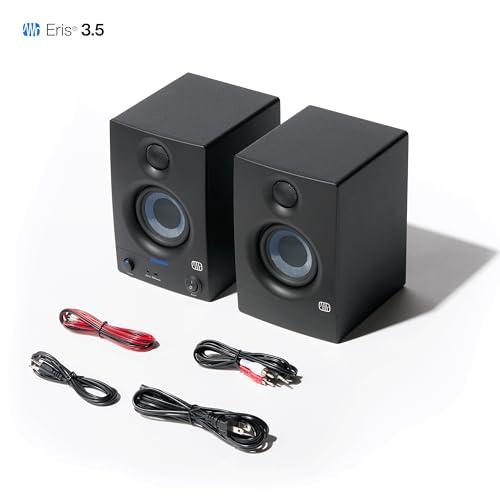
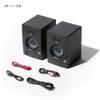
One area where the PreSonus Eris 3.5 truly shines is connectivity versatility. The rear panel offers both balanced 1/4-inch TRS inputs (professional standard) and unbalanced RCA inputs (consumer standard). This dual approach means whether you're connecting from a professional audio interface or directly from a computer's headphone output, you're covered.
The front-panel 1/8-inch auxiliary input proves surprisingly valuable in daily use. Researchers noted how convenient it is for quickly connecting phones or tablets without reaching around to the back panel – a small detail that significantly improves workflow in desktop setups.
The integrated headphone amplifier with automatic speaker muting represents thoughtful engineering. When you plug in headphones, the speakers automatically cut out, eliminating the need to manually adjust multiple volume controls. The headphone amp itself provides clean, powerful output that our testers found suitable for most headphone impedances.
Perhaps the most noteworthy feature setting these monitors apart from similarly-sized competitors is the inclusion of high and low-frequency tuning controls. These continuously variable controls provide ±6dB adjustment at 10kHz and 100Hz respectively.
In practical terms, this means you can compensate for your room's acoustic characteristics. If your desk sits in a corner where bass tends to build up, you can dial back the low-frequency control. If your room absorbs high frequencies (common in spaces with lots of soft furnishings), you can boost the treble slightly.
Our researchers emphasized how rare this level of acoustic customization is in the compact monitor category. Most competing products offer either no adjustment or simple bass/treble switches, making the Eris 3.5's approach significantly more sophisticated.
In listening tests, the PreSonus Eris 3.5 demonstrates impressive clarity and imaging for their size class. The stereo imaging – how well they create a sense of space and instrument placement – exceeds expectations for near-field desktop use. Vocals sit precisely in the center, and individual instruments maintain distinct positioning within the soundstage.
The frequency response, while generally balanced, does show some limitations inherent to the size constraints. Bass extension naturally rolls off below 80Hz, meaning the deepest bass frequencies in electronic music or film soundtracks won't be fully represented. The midrange can appear slightly recessed compared to larger monitors, though this characteristic is less noticeable in desktop applications where listening distance is shorter.
Harmonic distortion remains acceptably low at moderate listening levels but increases more rapidly at higher volumes compared to larger monitors. This suggests they're best suited for near-field applications rather than trying to fill larger rooms with sound.
In the context of today's compact monitor market, the Eris 3.5 occupies an interesting position. While newer products from companies like iLoud and Genelec offer even smaller form factors with DSP processing (digital signal processing that can correct frequency response), the PreSonus Eris 3.5 maintains relevance through its analog approach and comprehensive connectivity.
At the time of writing, the value proposition remains strong in the entry-level studio monitor category. The combination of genuine studio heritage, acoustic tuning options, and versatile connectivity typically requires stepping up to significantly more expensive alternatives to match.
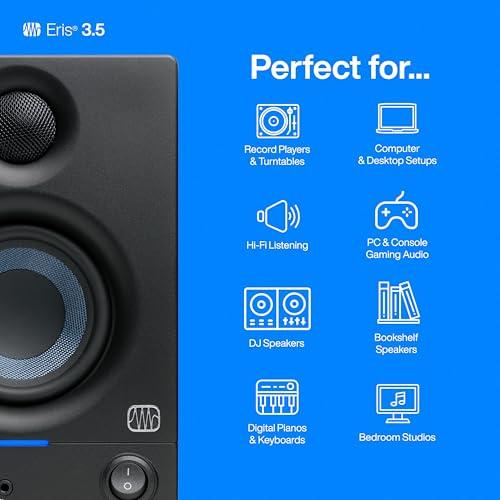
While primarily designed as studio monitors, some users explore the Eris 3.5 for home theater applications. Their compact size makes them attractive for desk-based media consumption, and the clear dialogue reproduction proves valuable for video content. However, the limited bass extension means they're better suited for nearfield multimedia use rather than full home theater systems where deeper bass response is typically desired.
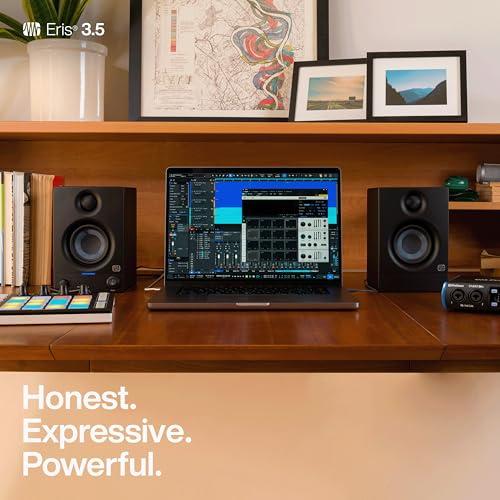
The Eris 3.5 makes most sense for content creators working in space-constrained environments, beginning music producers who need honest monitoring without large desktop footprint requirements, and anyone seeking studio-quality reproduction for computer-based audio work.
They're less suitable for bass-heavy music production, applications requiring high SPL capability, or situations where completely neutral frequency response is critical for professional mixing decisions.
The PreSonus Eris 3.5 Studio Monitors successfully deliver on their promise of bringing studio monitor accuracy to ultra-compact desktop applications. While they can't overcome the physics of small drivers, they maximize performance within those constraints through thoughtful engineering and genuine attention to audio quality.
Their greatest strength lies in democratizing professional audio monitoring for users who previously had to choose between space efficiency and sound quality. The comprehensive connectivity, acoustic tuning capabilities, and honest frequency response create a package that remains competitive in an increasingly crowded market.
For their intended applications, they represent a smart entry point into professional audio monitoring, offering genuine studio DNA in a form factor that actually fits modern workspace realities.
The PreSonus Eris 3.5 Studio Monitors Pair work well for desktop home theater setups and computer-based media consumption. Their clear dialogue reproduction and compact size make them ideal for nearfield viewing, though their limited bass extension means they're better suited for smaller spaces rather than full living room theater systems.
The PreSonus Eris 3.5 offers versatile connectivity including balanced 1/4" TRS inputs for audio interfaces, RCA inputs for TVs and media players, and a front-panel 3.5mm aux input for phones, tablets, and laptops. This makes them compatible with virtually any audio source in your home theater setup.
The PreSonus Eris 3.5 Studio Monitors Pair delivers 50 watts total system power with 25 watts per speaker using Class AB amplification. This provides sufficient volume for desktop and small room applications while maintaining clean, distortion-free sound.
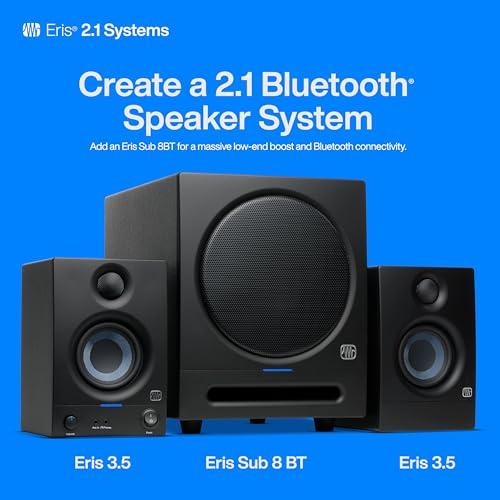
While the PreSonus Eris 3.5 can function standalone, adding a subwoofer significantly improves the home theater experience. The monitors' 80Hz low-frequency limit means deep bass effects in movies and music won't be fully reproduced without additional bass support.
Yes, the PreSonus Eris 3.5 Studio Monitors Pair includes high and low-frequency tuning controls that provide ±6dB adjustment at 10kHz and 100Hz. This allows you to customize the sound for your room acoustics and personal preferences, which is rare in compact monitors.
The PreSonus Eris 3.5 are active (powered) monitors with built-in amplifiers. This means you don't need a separate amplifier or receiver – just connect your audio source directly to the monitors, making setup simple for home theater applications.
Each PreSonus Eris 3.5 Studio Monitors measures 8.3" high × 5.6" wide × 6.5" deep, making them ideal for desktop setups, bookshelf placement, or smaller entertainment centers where space is limited.
Yes, the PreSonus Eris 3.5 includes a front-panel headphone output with a built-in amplifier. When you plug in headphones, the speakers automatically mute, providing convenient private listening for late-night movie watching.
The PreSonus Eris 3.5 Studio Monitors Pair is the most compact in the Eris line but has less bass extension compared to the 4.5" and 5" models. For home theater use, larger Eris models provide deeper bass and higher maximum volume, though they require more space.
The PreSonus Eris 3.5 Studio Monitors Pair offers excellent value for desktop home theater setups, content creation, and small-space audio applications. While they can't match larger monitors for deep bass or room-filling volume, their studio-accurate sound, versatile connectivity, and compact size make them worthwhile for users prioritizing space efficiency and honest audio reproduction.
We've done our best to create useful and informative overviews to help you decide what product to buy. Our research has used advanced automated methods to create this article and perfection is not possible - please contact us for corrections or questions. These are the sites we've researched in the creation of this article: soundref.com - presonus.com - musicradar.com - presonus.com - higherhertz.com - sweetwater.com - erinsaudiocorner.com - gzhls.at - homestudiobasics.com - presonus.com - audiosciencereview.com - youtube.com - audiosciencereview.com - thomannmusic.com - georgesmusic.com - musicalgarage.com - soundonsound.com
| PreSonus Eris 3.5 Studio Monitors Pair |
|---|
| Total System Power - Determines maximum volume and headroom: 50W (25W per speaker) |
| Frequency Response - Shows the range of sounds you'll hear: 80 Hz to 20 kHz |
| Driver Configuration - Larger drivers typically mean better bass: 3.5" woofer + 1" silk dome tweeter |
| Maximum SPL - How loud they can play without distortion: 98 dB peak at 1 meter |
| Acoustic Tuning Controls - Lets you adjust sound for your room: ±6 dB at 10 kHz and 100 Hz |
| Input Options - More inputs mean greater connectivity flexibility: Balanced TRS, RCA, and 3.5mm aux |
| Amplifier Type - Class AB offers warm sound with low distortion: Dual Class AB amplification |
| Cabinet Material - Dense materials reduce unwanted vibrations: Vinyl-laminated MDF |
| Crossover Frequency - Where woofer hands off to tweeter: 2.8 kHz |
| Headphone Output - Built-in amp with automatic speaker muting: Front panel 3.5mm with dedicated amplifier |
| Protection Features - Prevents damage from power issues: RF filtering, current limiting, thermal protection |
| Power Saving - Reduces energy consumption when idle: Auto standby after 40 minutes |
| Dimensions (per speaker): 8.3" H × 5.6" W × 6.5" D |
| Weight (pair): 6.8 lbs |
The Logitech Z207 Bluetooth Computer Speakers take a completely different approach, prioritizing wireless convenience and multi-device connectivity over studio-grade accuracy. Their standout feature is Easy-Switch technology, which maintains simultaneous connections to two Bluetooth devices plus one wired input, allowing seamless switching between your laptop, phone, and other sources without any re-pairing hassle. At roughly one-third the cost of the Eris 3.5, the Z207 delivers surprisingly good sound quality for casual listening, with passive radiators that provide enhanced bass presence despite their compact 2.2-pound total weight. The four-driver design and consumer-friendly tuning make music streaming, video calls, and gaming more engaging, even if they lack the neutral accuracy needed for professional work.
While the Logitech Z207 can't match the Eris 3.5's 50-watt power output or flat frequency response, they excel in scenarios where convenience trumps precision. The wireless range extends up to 20 meters, front-panel controls are intuitive, and the compact desktop footprint won't dominate your workspace like larger studio monitors. For users who primarily consume rather than create audio content—streaming Spotify, attending Zoom calls, or casual gaming—the Z207's enhanced bass and hassle-free operation provide better real-world value. However, their 10-watt output and 120Hz low-frequency limit mean they're unsuitable for serious audio work, large rooms, or anyone who needs the reference-quality monitoring that the Eris 3.5 provides. The choice ultimately comes down to whether you need professional accuracy or prefer modern wireless convenience at a budget-friendly price point.
🤖 Read Detailed Comparison
👌Logitech Z207 Bluetooth Computer Speakers Details
💵 See Logitech Z207 Bluetooth Computer Speakers Price
The Saiyin Bluetooth Bookshelf Speakers take a fundamentally different approach, prioritizing modern convenience and consumer-friendly features over studio accuracy. Their standout advantage is Bluetooth 5.0 wireless connectivity, eliminating the cable management that comes with the Eris 3.5's wired-only design. The larger woofers—up to 5.2 inches in some models compared to the Eris 3.5's 3.5-inch drivers—deliver noticeably deeper bass response and higher peak volume levels, making them more satisfying for casual music listening and home theater applications. The multiple digital inputs including optical and coaxial connections provide seamless TV integration, while the dedicated subwoofer output offers an expansion path that the Eris 3.5 simply doesn't provide.
However, these consumer-focused benefits come with trade-offs in accuracy and professional capability. The Saiyin speakers lack the acoustic tuning controls that make the Eris 3.5 adaptable to different room environments, and their enhanced bass response, while enjoyable for entertainment, makes them less suitable for critical listening or audio production work. The build quality also reflects their consumer market positioning, with attractive wood finishes prioritized over the professional-grade components and protection circuits found in the Eris 3.5. For users who primarily stream music wirelessly, watch movies, or want speakers that blend into home décor while providing good sound quality, the Saiyin speakers offer compelling value. But for anyone serious about audio accuracy—whether for production work or critical listening—the Eris 3.5's studio monitor heritage and flat frequency response provide capabilities that consumer bookshelf speakers simply cannot match.
🤖 Read Detailed Comparison
👌Saiyin Bluetooth Bookshelf Speakers Pair Details
💵 See Saiyin Bluetooth Bookshelf Speakers Pair Price
The Kanto ORA takes a fundamentally different approach to desktop audio, prioritizing modern connectivity and automated optimization over the Eris 3.5's traditional studio monitor philosophy. Where the Eris 3.5 requires manual room tuning and relies on analog connections, the ORA delivers plug-and-play convenience through USB-C digital input with 24-bit/96kHz support, Bluetooth 5.0 wireless streaming, and automatic DSP processing that optimizes sound without user intervention. The bi-amplified Class-D design provides 100W peak power with dedicated amplifiers for each driver, resulting in better dynamic range and the ability to maintain clarity at higher volumes. Perhaps most significantly, the ORA includes automatic subwoofer integration with a 100Hz digital crossover that seamlessly blends with powered subwoofers, eliminating the manual setup and potential phase issues that plague traditional monitor configurations.
In real-world use, the Kanto ORA excels in scenarios where the Eris 3.5's limitations become apparent. Content creators who frequently switch between devices will appreciate the wireless connectivity and multiple digital inputs, while the compact form factor and lightweight construction make repositioning effortless. The automatic DSP processing creates a more forgiving and enjoyable listening experience for extended sessions, though purists may prefer the Eris 3.5's uncolored accuracy for critical mixing work. However, this convenience comes at a significantly higher price point, positioning the ORA as a premium desktop solution for users who value modern features and automated optimization over the Eris 3.5's straightforward, budget-conscious approach to studio monitoring. For users seeking the ultimate in desktop audio flexibility with reference-quality sound, the ORA justifies its premium pricing, but those prioritizing pure accuracy and value will find the Eris 3.5's honest reproduction and manual controls more aligned with traditional studio monitoring needs.
🤖 Read Detailed Comparison
👌Kanto ORA Powered Reference Desktop Speakers Pair Details
💵 See Kanto ORA Powered Reference Desktop Speakers Pair Price
The Creative Pebble V2 takes a fundamentally different approach to desktop audio, prioritizing extreme convenience and affordability over professional accuracy. These compact speakers excel in their simplicity—USB-C power eliminates wall adapters entirely, while their spherical design and 45-degree angled drivers direct sound efficiently toward seated listeners. At roughly one-fifth the cost of the Eris 3.5, the Pebble V2 delivers surprisingly full sound through clever engineering, using passive radiators to extend bass response from their tiny full-range drivers. For students, casual listeners, or anyone setting up temporary workspaces, this plug-and-play approach offers genuine appeal with minimal desk footprint and zero setup complexity.
However, the performance gap becomes apparent in direct comparison. The Pebble V2's 8-watt total output and single-driver design can't match the Eris 3.5's dedicated woofer-tweeter configuration, resulting in less detailed midrange and limited dynamic range. While the Creative Pebble V2 makes music sound exciting with its enhanced frequency response, this coloration works against accurate monitoring for content creation. The plastic construction also introduces resonances at higher volumes that the Eris 3.5's MDF cabinets avoid. Ultimately, the Pebble V2 succeeds brilliantly at its intended purpose—dramatically improving basic computer audio at an accessible price—but it operates in a different performance class entirely, making it ideal for casual use while the Eris 3.5 serves users who need professional-grade accuracy and power.
🤖 Read Detailed Comparison
👌Creative Pebble V2 Desktop Speakers Details
💵 See Creative Pebble V2 Desktop Speakers Price
The Edifier R1280T stands out with its larger 4-inch woofers that deliver significantly deeper bass extension down to 52Hz, compared to the Eris 3.5's 80Hz limit. This size advantage translates to more room-filling, impactful low-end that makes music, movies, and games feel more engaging and immersive. The speakers feature a consumer-friendly design with front-panel tone controls, dual RCA inputs for connecting multiple sources simultaneously, and a wireless remote for convenient volume and mute control. The wood-grain MDF construction provides an attractive aesthetic that fits better in living spaces, while the front-ported design enhances bass response for listeners positioned directly in front of the speakers.
In practical use, the Edifier R1280T excels where the Eris 3.5's clinical accuracy might feel lacking – pure entertainment and musical enjoyment. Its warmer, more colored sound signature makes poorly recorded music more listenable and adds richness to vocals and instruments that many users find immediately satisfying. The larger drivers and 21-watt-per-channel amplification create a fuller soundstage that works better for background listening and larger desk setups. While it can't match the Eris 3.5's professional connectivity or neutral monitoring capabilities, the R1280T offers superior value for users who prioritize musical engagement over technical accuracy, making it the better choice for vinyl enthusiasts, casual listeners, and anyone wanting speakers that enhance rather than merely reproduce their audio content.
🤖 Read Detailed Comparison
👌Edifier R1280T Powered Bookshelf Speakers Pair Details
💵 See Edifier R1280T Powered Bookshelf Speakers Pair Price
The Edifier R980T takes a consumer-focused approach that prioritizes musical enjoyment over clinical accuracy. Its standout feature is the flared bass reflex port design that delivers significantly more impactful low-end response than the Eris 3.5's controlled output, making music, games, and movies feel more exciting and engaging. The larger 4-inch woofer moves more air for fuller bass presence, while the dual RCA input system offers practical convenience that studio monitors typically lack – you can connect both a computer and turntable simultaneously without constantly swapping cables. At roughly half the cost of the Eris 3.5, the R980T delivers solid MDF construction with an attractive wood veneer finish that looks more at home in living spaces than professional studio gear.
For everyday use, the Edifier R980T provides immediate satisfaction that many users prefer over the Eris 3.5's honest but potentially underwhelming sound signature. The enhanced bass response makes electronic music, hip-hop, and action movies more thrilling, while the plug-and-play simplicity requires no audio interface or technical knowledge to achieve good results. However, this consumer tuning comes with trade-offs – the recessed midrange can bury vocals and the lower 24W power output leads to distortion at high volumes where the Eris 3.5 remains clean. If you're doing any audio production work, the R980T's colored sound signature will mislead your mixing decisions, but for casual listening, gaming, and general entertainment, it offers better value and more engaging sound than the clinical accuracy of studio monitors.
🤖 Read Detailed Comparison
👌Edifier R980T Bookshelf Speakers Pair Details
💵 See Edifier R980T Bookshelf Speakers Pair Price
The Klipsch Reference R-41PM deliver significantly more versatile connectivity with Bluetooth wireless streaming, USB-B input supporting high-resolution 24-bit/96kHz audio, optical digital input for TVs and gaming consoles, and a built-in phono preamp for direct turntable connection. Their horn-loaded tweeter technology provides exceptional efficiency and clarity, while the larger 4-inch copper IMG woofers offer substantially more bass impact and midrange presence. The 70W total power output (versus the Eris 3.5's 50W) enables room-filling sound without strain, and unique features like Dynamic Bass EQ automatically adjust low-frequency response based on volume levels. The dedicated subwoofer output makes future expansion simple, and the IR remote control adds convenience for source switching and volume adjustment from across the room.
While the Klipsch speakers require more desk space and cost more initially, they address the Eris 3.5's most significant weakness—that problematic midrange recession—with balanced frequency response that makes vocals and instruments sound natural and present. The extensive connectivity options provide genuine long-term value, essentially incorporating a wireless receiver, USB DAC, and phono preamp into the speakers themselves. For users who can accommodate the larger footprint, the R-41PM offer dramatically better sound quality, much greater versatility across different sources and use cases, and superior performance for music listening, gaming, and home theater applications. The price premium pays dividends in both immediate performance and future-proofing against changing connectivity needs.
🤖 Read Detailed Comparison
👌Klipsch Reference R-41PM Powered Bookshelf Speakers Pair Details
💵 See Klipsch Reference R-41PM Powered Bookshelf Speakers Pair Price
Original price was: $1,799.99.$1,298.99Current price is: $1,298.99.
Original price was: $499.99.$369.99Current price is: $369.99.
Original price was: $579.99.$318.99Current price is: $318.99.


Privacy Policy
Terms and Conditions - Affiliate Policy
Home Security
© Copyright 2008-2026.
11816 Inwood Rd #1211, Dallas, TX 75244