

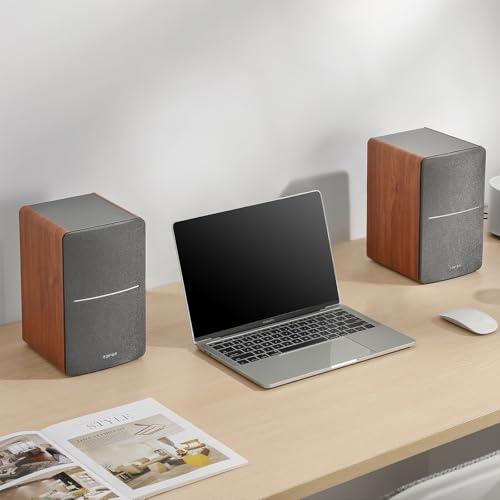
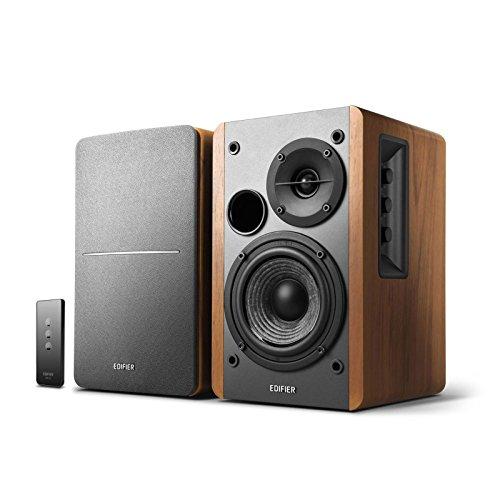

When it comes to upgrading your computer's audio, the world of desktop speakers can feel overwhelming. Built-in laptop speakers or basic monitor audio just don't cut it for music, gaming, or video content, but with dozens of options at every price point, how do you choose? Today we're comparing two speakers that represent fundamentally different approaches to desktop audio: the Edifier R1280T, a traditional bookshelf speaker adapted for desktop use, and the Creative Pebble V2, a compact speaker designed specifically for modern workspaces.
These aren't just random picks—they're two of the most recommended speakers in their respective categories, and understanding their differences will help you figure out what type of desktop audio setup works best for your needs, space, and budget.
Before diving into specifics, let's talk about what actually matters in desktop speakers. Unlike home theater systems or professional studio monitors, desktop speakers need to work well in a very specific environment: close to your ears, on or near your desk, often in smaller rooms.
The most important performance metrics for desktop speakers include frequency response (how evenly they reproduce different pitches), power output (how loud they can get without distorting), driver quality (the actual speakers inside that move air to create sound), and soundstage (how wide and immersive the audio feels). For desktop use, you also need to consider size constraints, connectivity options, and whether you need features like tone controls or multiple inputs.
The Edifier R1280T and Creative Pebble V2 represent two completely different philosophies. The Edifier follows the traditional approach: larger drivers, separate tweeters and woofers, built-in amplification, and the assumption that you have decent desk space. The Creative takes the modern compact route: tiny footprint, USB power, and clever engineering to squeeze surprising performance from a minimal package.
Released around 2018, the Edifier R1280T belongs to a family of powered bookshelf speakers that gained popularity as people started taking desktop audio more seriously. At the time of writing, it sits in the mid-budget range for desktop speakers—not the cheapest option, but far from premium pricing.
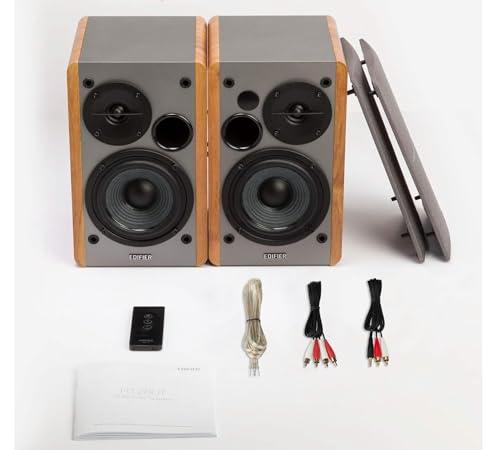
The R1280T uses what's called a 2-way design, meaning it has separate drivers optimized for different frequency ranges. Each speaker contains a 4-inch mid-range/bass driver (the larger cone that handles vocals, instruments, and low frequencies) and a 13mm silk dome tweeter (a small, specialized driver just for high frequencies like cymbals and vocal clarity). This separation is crucial because no single driver can perfectly reproduce the entire range of human hearing.
The silk dome tweeter deserves special mention. Unlike cheaper metal or plastic tweeters that can sound harsh or fatiguing, silk domes produce smoother, more natural highs. After hours of listening to music or gaming, this difference becomes really noticeable—your ears just don't get as tired.
Powering these drivers is a built-in Class-D amplifier rated at 42 watts RMS total (21 watts per speaker). Class-D amplifiers are efficient and run cool, which is perfect for desktop use where the speakers might be on for hours at a time. This power rating isn't just a marketing number—it translates to real-world capability to fill medium-sized rooms and maintain clarity even at high volumes.
Based on extensive user feedback and professional reviews, the R1280T delivers what most people would call a warm, balanced sound signature. This means vocals sit prominently in the mix (great for podcasts, YouTube videos, and vocal-heavy music), while bass is present and punchy without being overwhelming. The frequency response extends from about 75Hz on the low end up to 18kHz on the high end—covering almost all of human hearing.
That 75Hz low-end extension is particularly impressive for speakers this size. To put it in perspective, that's low enough to reproduce the fundamental frequencies of most bass guitars and kick drums, though you won't get the ultra-deep sub-bass that makes movie explosions shake your room.
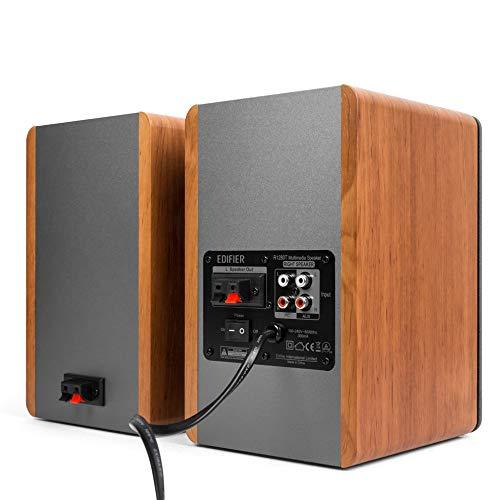
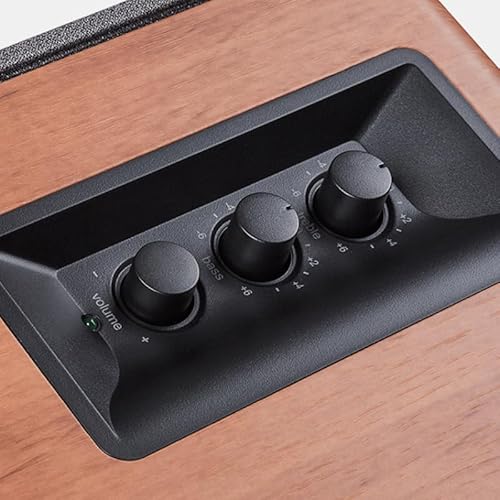
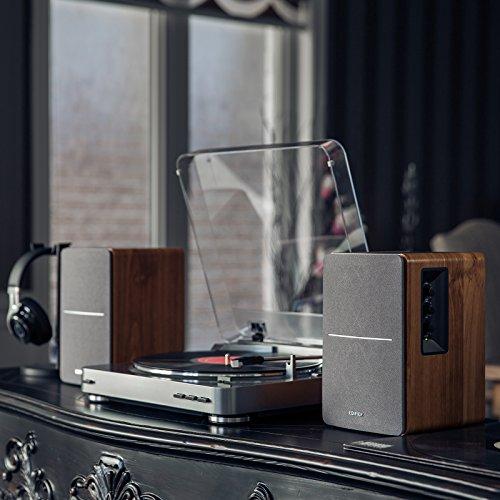
One standout feature of the R1280T is its dual RCA inputs. This might sound boring, but it's incredibly practical—you can have your turntable connected to one input and your computer to the other, switching between them without unplugging cables. The speakers also include bass and treble controls (±6dB adjustment range) and come with a wireless remote for volume control.
For home theater use, the R1280T can work as front speakers in a budget setup, though the lack of a dedicated subwoofer output limits expansion possibilities. They're really designed as a complete 2.0 system rather than part of a larger surround sound setup.
The Creative Pebble V2 represents a more recent approach to desktop audio, released around 2020 when remote work and compact living spaces became more important to many people. At the time of writing, these speakers sit firmly in the budget category, costing significantly less than the R1280T while trying to deliver surprisingly good performance from an impossibly small package.
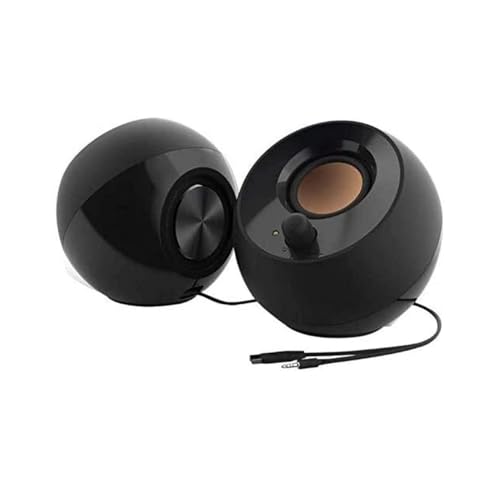
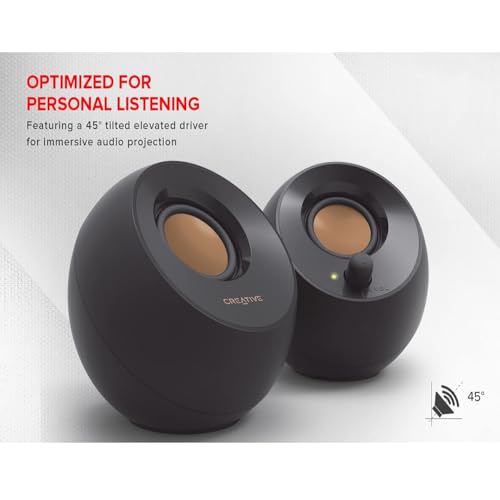
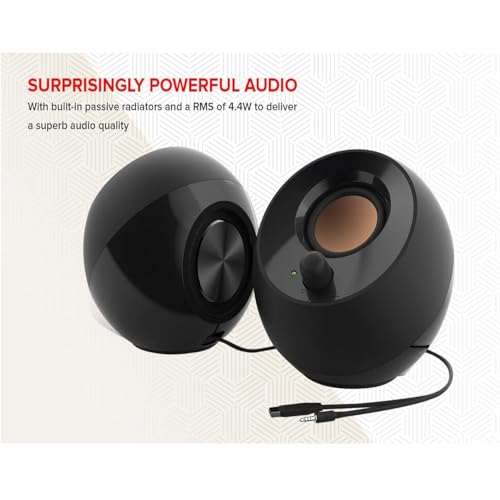
Where the Edifier uses brute force (bigger drivers, more power), the Pebble V2 relies on clever engineering. Each speaker contains a 2-inch full-range driver—meaning one driver handles all frequencies instead of separate woofers and tweeters. Normally, this would be a compromise, but Creative adds passive radiators on the back of each speaker.
Passive radiators are fascinating pieces of engineering. They look like drivers but have no magnet or voice coil—instead, they're tuned to vibrate sympathetically with the main driver, effectively extending bass response. Think of them as resonators that help these tiny speakers produce more low-end than should be physically possible.
The speakers are angled at 45 degrees, directing sound toward your ears rather than past them. This near-field optimization means they're designed to sound their best when you're sitting close—perfect for desktop use, less ideal for filling a room.
The Pebble V2 draws power through USB-C (with a USB-A adapter included), outputting up to 8 watts RMS total when connected to a high-power USB port. This is substantially less than the R1280T's 42 watts, but the comparison isn't entirely fair—the Pebbles are designed for personal listening, not room-filling audio.
The frequency response spans 100Hz to 17kHz, which on paper seems narrower than the Edifier. However, user reports suggest the passive radiators help extend perceived bass response beyond what those numbers might indicate. Still, physics is physics—2-inch drivers in tiny enclosures simply cannot move the air volume that 4-inch drivers in larger boxes can manage.
Using USB power isn't just about convenience—it's about desk real estate and cable management. The Pebble V2 needs only two connections: one USB cable for power and one 3.5mm audio cable. No wall adapter, no power brick under your desk. For people with limited outlets or those who frequently rearrange their workspace, this simplicity is genuinely valuable.
The gain switch on the bottom allows the speakers to automatically adjust their output based on available USB power. Connect to a high-power port and get maximum performance; connect to a lower-power port and they'll scale back to prevent issues.
In pure audio quality, the R1280T wins decisively, and it's not particularly close. The larger drivers, separate tweeter/woofer design, and more powerful amplification create a more complete, detailed sound. Vocals have more body, instruments have better separation, and the overall presentation is more convincing.
The Pebble V2 punches well above its weight for such a compact design, delivering surprisingly clear mids and impressive bass considering the size constraints. But they're optimized for near-field listening—they sound their best when you're sitting close, and the sound quality degrades more noticeably as you move away or increase volume.
This is where the power difference becomes most apparent. The R1280T can comfortably fill a medium-sized room with clear, undistorted audio. They maintain their composure at high volumes and can deliver the dynamic range needed for movie soundtracks or energetic music.
The Pebble V2 is fundamentally a personal audio solution. They can get reasonably loud for desktop listening, but pushing them hard reveals their limitations. The sound becomes compressed, and the small drivers struggle with complex musical passages at higher volumes.
Low-frequency reproduction showcases the fundamental difference between these approaches. The R1280T's 4-inch drivers and properly tuned bass reflex ports deliver genuine bass extension. You can feel kick drums and bass guitars, and the low-end has weight and impact.
The Pebble V2's passive radiator design creates the impression of more bass than you'd expect from 2-inch drivers, but it's more about enhanced mid-bass than true deep bass extension. It's effective for pop music, podcasts, and general computer audio, but won't satisfy bass-heavy music lovers or provide the foundation for movie soundtracks.
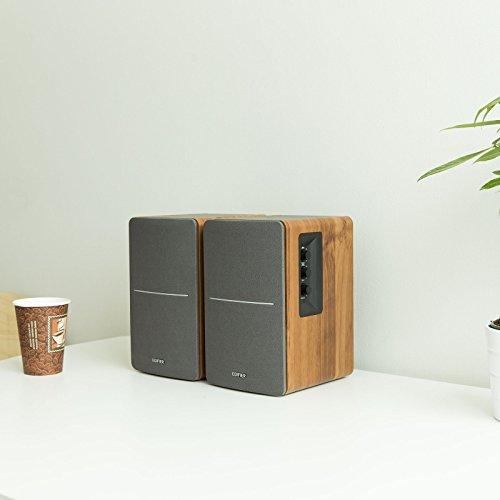
This might be the deciding factor for many people. The R1280T speakers are substantial—each one measures about 5.75 by 9.5 by 7 inches. They need dedicated space on your desk or nearby shelves, and proper positioning (ideally forming a triangle with your listening position) is important for optimal sound.
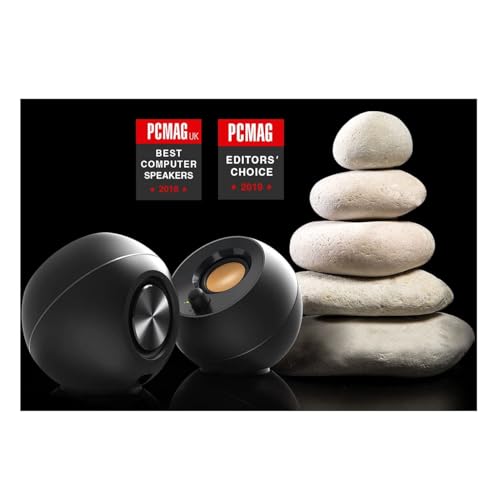
The Pebble V2 speakers are roughly the size of large oranges. They sit unobtrusively on either side of your monitor, taking up minimal space and working well even in cramped quarters. For people with small desks, multiple monitors, or those who frequently travel with their setup, this compactness is a genuine advantage.
The Creative speakers embody the plug-and-play philosophy. Connect power and audio, adjust the volume, and you're done. The 45-degree angle means they're already optimized for desktop positioning.
The Edifier speakers require more thought. You'll need to position them properly for good stereo imaging, potentially adjust the bass and treble controls to suit your room and preferences, and manage more cables (power, audio, and the connection between speakers).
The R1280T's dual RCA inputs prove surprisingly useful in practice. Many users connect both a computer and a turntable, or a computer and a gaming console, eliminating the need to constantly swap cables. The included remote control and tone controls add convenience for daily use.
The Pebble V2 keeps things simple with a single 3.5mm input. This works fine if all your audio sources connect through your computer, but limits flexibility for users with multiple devices.
At the time of writing, these speakers operate in different price categories, which makes direct value comparison tricky. The R1280T costs roughly three times more than the Pebble V2, but delivers substantially more than three times the performance in most measurable ways.
The Creative speakers represent exceptional value in the ultra-budget category. For someone upgrading from built-in laptop speakers or basic earbuds, the improvement is dramatic and immediately noticeable. They're also ideal for people who aren't sure if they want to invest heavily in desktop audio—a low-risk way to test whether better speakers improve your daily computer experience.
The Edifier speakers offer more traditional audiophile value—genuinely good sound at a reasonable price. They compete favorably with passive bookshelf speakers plus separate amplifiers costing significantly more. For someone who spends hours daily at their computer and cares about audio quality, the extra investment makes sense.
Neither speaker is primarily designed for home theater use, but they can work in different scenarios. The R1280T could serve as front speakers in a budget desktop-based home theater setup, particularly for smaller rooms. They have the power and frequency response to handle movie dialogue and music reasonably well, though the lack of a subwoofer output limits expansion options.
The Pebble V2 isn't really suitable for home theater use. They lack the power and low-frequency extension needed for movie soundtracks, and their near-field optimization means they don't work well at the distances typical in home theater setups.
Choose the Edifier R1280T if:
Choose the Creative Pebble V2 if:
Both speakers succeed at their intended purposes, but they're solving different problems. The Edifier R1280T prioritizes audio performance and versatility, accepting the trade-offs in size and cost to deliver genuinely impressive sound quality. The Creative Pebble V2 prioritizes convenience and value, using clever engineering to deliver surprisingly good performance from an impossibly compact package.
Your choice should align with your priorities, space constraints, and how much you value audio quality in your daily computer use. Neither choice is wrong, but understanding these fundamental differences will help you pick the speakers that best match your specific needs and expectations.
The desktop speaker market has evolved significantly over the past few years, with options now available for virtually every budget and space constraint. Whether you go with traditional bookshelf-style speakers or modern compact designs, upgrading from built-in audio will transform your daily computer experience in ways you might not expect until you make the switch.
| Edifier R1280T Powered Bookshelf Speakers | Creative Pebble V2 Desktop Speakers |
|---|---|
| Total Power Output - Determines maximum volume and dynamic range | |
| 42W RMS (21W per speaker) - Can fill medium rooms | 8W RMS (4W per speaker) - Optimized for desktop listening |
| Driver Configuration - Affects sound quality and frequency separation | |
| 2-way design: 4" mid/bass + 13mm silk dome tweeter | Single 2" full-range driver + passive radiators |
| Frequency Response - Shows how deep the bass goes and how crisp the highs are | |
| 75Hz - 18kHz (better bass extension) | 100Hz - 17kHz (limited by smaller drivers) |
| Size per Speaker - Critical for desk space planning | |
| 5.75" × 9.5" × 7" (requires significant desk space) | ~4.5" diameter spherical (minimal footprint) |
| Power Source - Affects setup complexity and portability | |
| AC wall power (more power, requires outlet) | USB-C/USB-A powered (convenient, no wall outlet needed) |
| Audio Inputs - Determines how many devices you can connect | |
| Dual RCA inputs (connect turntable + computer simultaneously) | Single 3.5mm AUX input (one device at a time) |
| Controls and Features - Convenience factors for daily use | |
| Bass/treble controls, volume knob, wireless remote | Simple volume knob with gain switch, no tone controls |
| Positioning - How they need to be placed for best sound | |
| Traditional bookshelf placement, manual positioning required | 45° angled drivers, pre-optimized for desktop use |
| Value Proposition - Performance per dollar considerations | |
| Mid-range price for genuine audiophile performance | Budget price for maximum improvement over built-in speakers |
The Edifier R1280T is significantly better for music listening due to its larger 4-inch drivers, separate tweeter design, and 42W of power. It delivers fuller bass, clearer vocals, and better instrument separation. The Creative Pebble V2 works well for casual music listening at your desk but lacks the depth and clarity for serious music enjoyment.
The Creative Pebble V2 requires minimal desk space with its compact 4.5-inch spherical design that fits beside most monitors. The Edifier R1280T needs substantial space at nearly 10 inches tall and 6 inches wide per speaker, requiring dedicated desk real estate or nearby shelves for proper placement.
The Edifier R1280T gets much louder with its 42W RMS power output compared to the Creative Pebble V2's 8W RMS. The Edifier can fill medium-sized rooms while maintaining clarity, whereas the Pebble V2 is optimized for personal desktop listening and may distort at high volumes.
Both work well for gaming but serve different needs. The Creative Pebble V2 excels for competitive gaming where space is limited and you need clear directional audio. The Edifier R1280T provides better immersion for single-player games with its superior bass response and wider soundstage, making explosions and music more impactful.
The Creative Pebble V2 wins for simplicity - just connect USB power and a 3.5mm audio cable. The Edifier R1280T requires more setup with AC power, proper speaker positioning, and potentially adjusting bass/treble controls for your room, though it includes helpful tone adjustment features.
The Edifier R1280T features dual RCA inputs, allowing simultaneous connections to devices like your computer and turntable without cable swapping. The Creative Pebble V2 has only one 3.5mm input, requiring you to disconnect and reconnect different audio sources or use your computer as a hub.
The Edifier R1280T delivers significantly better bass with its larger 4-inch drivers and bass reflex ports, extending down to 75Hz for genuine low-frequency impact. The Creative Pebble V2 uses passive radiators to enhance bass beyond what its 2-inch drivers normally provide, but physics limits how deep it can go.
The Edifier R1280T can work as front speakers in a budget desktop home theater setup for smaller rooms, providing adequate power and frequency response for movies and TV shows. The Creative Pebble V2 isn't suitable for home theater due to its limited power output and near-field optimization designed for close listening.
This depends on your budget and needs. The Creative Pebble V2 offers exceptional value in the ultra-budget category, delivering massive improvement over built-in speakers. The Edifier R1280T provides better audiophile value with genuine high-quality sound that competes with much more expensive speaker systems.
The Edifier R1280T works excellently with turntables through its RCA inputs and is popular among vinyl enthusiasts for its warm, balanced sound signature. The Creative Pebble V2 can work with turntables using adapters, but its compact design and limited bass response don't complement vinyl listening as well.
The Creative Pebble V2 is ideal for space-constrained living situations due to its tiny footprint, USB power (no wall outlet needed), and optimized near-field performance. The Edifier R1280T requires more space and may produce too much bass for thin walls, though it offers superior sound quality if space allows.
The Edifier R1280T includes bass and treble controls with ±6dB adjustment range, plus a wireless remote for convenient volume control, allowing you to tune the sound to your preferences and room acoustics. The Creative Pebble V2 offers only volume control and a gain switch, with no tone adjustment capabilities.
We've done our best to create useful and informative comparisons to help you decide what product to buy. Our research uses advanced automated methods to create this comparison and perfection is not possible - please contact us for corrections or questions. These are the sites we've researched in the creation of this article: bestbuy.com - kbaudio.co.uk - everydaylistening.net - hometechnologyreview.com - soundguys.com - recordbuilds.com - audiosciencereview.com - edifier-online.com - youtube.com - audiosciencereview.com - tomsguide.com - youtube.com - youtube.com - audiosciencereview.com - hometechnologyreview.com - edifier.com - audiostance.com - usa-oss.edifier.com - edifier-online.com - edifier.com - youtube.com - edifier.com - bestbuy.com - audiosciencereview.com - kbaudio.co.uk - officedepot.com - techspinreview.com - cdw.com - youtube.com - richardtech.net - manuals.plus - audiosciencereview.com - us.creative.com - en.creative.com - youtube.com - audiosciencereview.com - lenovo.com - tomshardware.com - youtube.com - manuals.plus - youtube.com - youtube.com - walmart.com - dell.com - youtube.com - microcenter.com - cdwg.com - tvffm.org - asset.conrad.com - us.creative.com - manuals.plus - pangoly.com

Privacy Policy
Terms and Conditions - Affiliate Policy
Home Security
© Copyright 2008-2026.
11816 Inwood Rd #1211, Dallas, TX 75244