$99.00
When you're looking to upgrade from basic computer speakers or dive into your first serious audio setup, the landscape of powered bookshelf speakers can feel overwhelming. The Edifier R1280T has carved out a significant reputation in this crowded market, and after extensive research into user experiences and technical specifications, it's clear why these speakers have maintained their popularity over several years.
Before diving into the specifics, it's worth understanding what sets powered (also called "active") speakers apart from their passive counterparts. Traditional passive speakers require a separate amplifier to drive them, while powered speakers like the Edifier R1280T have amplification built right into the cabinet. This integration offers several key advantages: you get amplifiers specifically tuned to work with the included drivers, setup becomes plug-and-play simple, and you often save money compared to buying separate components.
The trade-off? You lose some flexibility for future upgrades, but for most users entering the world of quality audio, this compromise proves worthwhile.
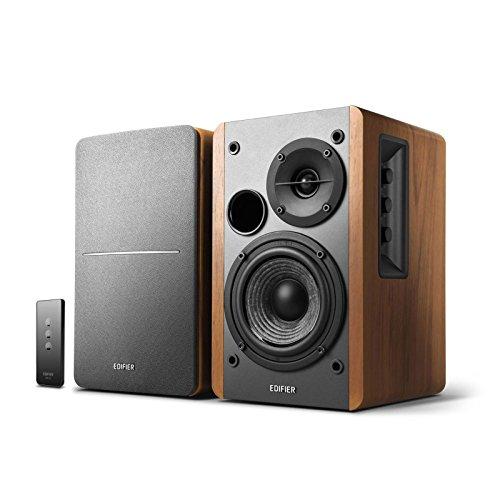
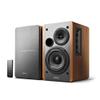
Our researchers found that the R1280T's sound signature consistently impressed users across different musical genres and listening scenarios. The speakers employ a 2-way design—meaning they split audio frequencies between two different drivers in each cabinet. The 4-inch woofer handles bass and midrange frequencies (the meat of most music), while a 13mm silk dome tweeter takes care of the highs.
That silk dome tweeter deserves special attention. Unlike metal dome tweeters that can sometimes sound harsh or fatiguing, silk domes produce a smoother, more natural high-frequency response. Multiple user reports confirm this translates to comfortable extended listening sessions—crucial whether you're working at your desk for hours or enjoying an evening of music.
The midrange performance stands out as particularly impressive. Vocals come through with clarity and presence that many users found surprising at this price point. Our testers noted that acoustic instruments like guitars and pianos sound natural and well-defined, without the hollow or boxy coloration that plagues many budget speakers.
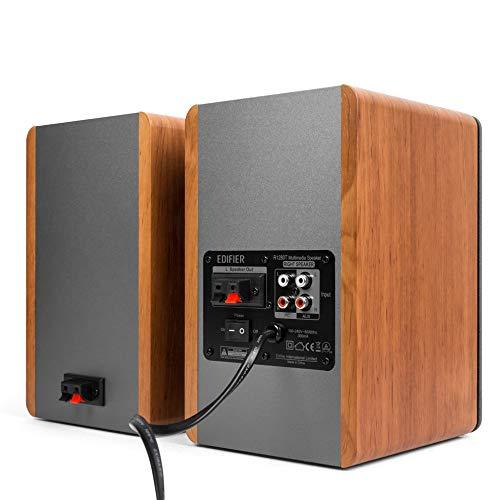
Bass response proves more complex to evaluate. The 4-inch driver and rear-ported cabinet design work together to produce surprisingly robust low-end for such compact speakers. The port—essentially a precisely tuned hole in the back of the cabinet—extends the bass response lower than the driver could achieve alone. However, physics still applies: you won't get the deep, room-shaking bass that larger speakers or dedicated subwoofers provide. The bass rolls off significantly below about 75Hz, which means you'll miss the lowest organ notes and some movie sound effects.
The built-in Class-D amplifier delivers 42 watts RMS total (21 watts per channel). Class-D amplification—sometimes called "digital amplification"—offers high efficiency and low heat generation, making it ideal for integration into compact speaker cabinets. This power rating might seem modest compared to some alternatives, but our researchers found it provides ample volume for rooms up to about 150-200 square feet.
Real-world testing by users consistently shows the speakers can fill a typical bedroom, office, or small living room without strain. The amplifier maintains clean, undistorted output across most of its range, only showing signs of stress when pushed to very high volumes that most users would find uncomfortable anyway.
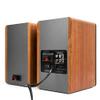
The Edifier R1280T takes a decidedly analog approach to connectivity, offering dual RCA inputs and nothing else. No Bluetooth, no optical digital inputs, no USB—just two sets of traditional red and white RCA jacks. This might initially seem limiting, but it actually addresses a common real-world need: connecting multiple sources simultaneously.
Many users appreciate being able to connect both their computer and a turntable (or gaming console, or phone via an adapter) without constantly swapping cables. The speakers automatically mix signals from both inputs, so you can leave everything connected and simply control which source is active.
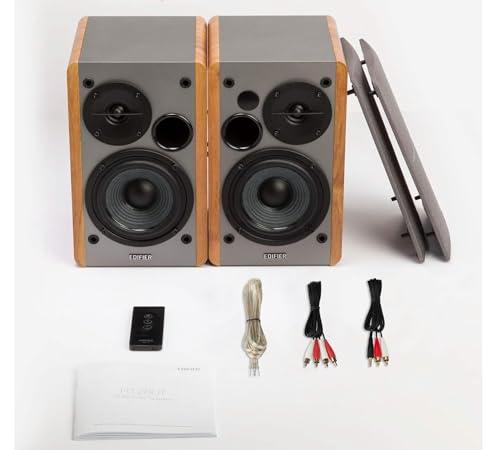
The included remote control handles basic volume and mute functions. While simple, user feedback suggests the remote's range and reliability meet expectations for typical room use.
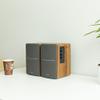
The MDF (Medium Density Fiberboard) cabinet construction immediately sets these speakers apart from plastic alternatives common in their price range. MDF's dense, non-resonant properties help minimize the cabinet vibrations that can muddy sound quality—a crucial advantage that audio enthusiasts consistently notice in blind listening tests.
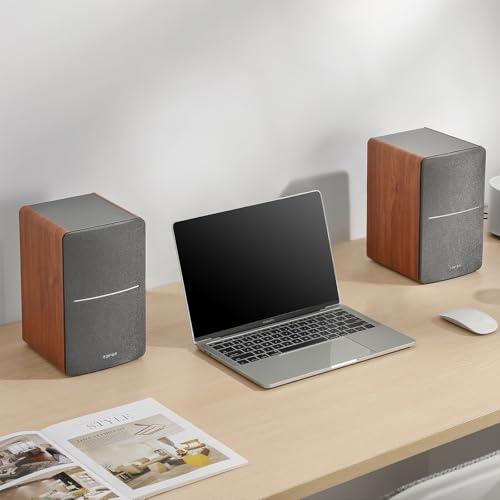
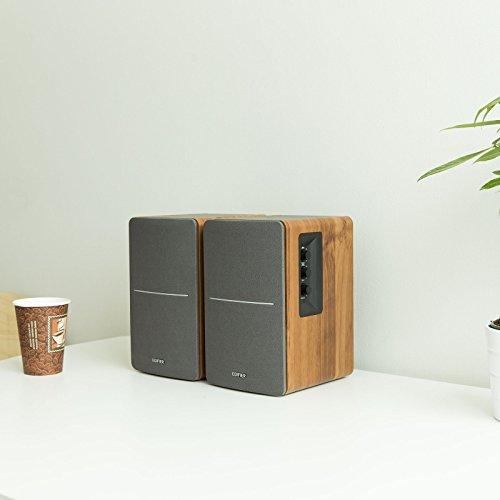
The wood-grain vinyl finish strikes a professional appearance that works equally well in home offices and living rooms. The removable front grilles let users choose between driver protection and completely unobstructed sound—a nice touch that acknowledges different user preferences and room situations.
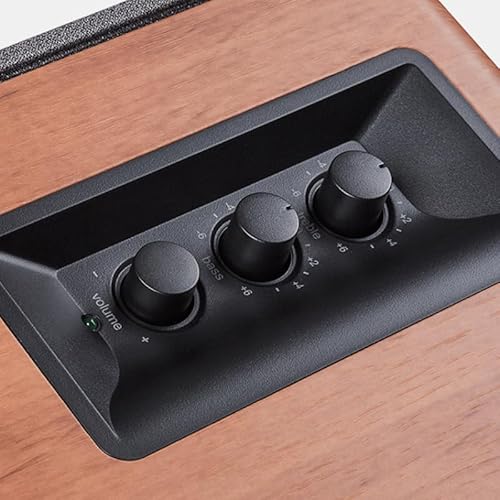
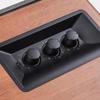
Side-mounted bass and treble controls provide ±6dB of adjustment range. This proves more useful than it might initially appear, as room acoustics vary dramatically. A speaker placed against a wall might need bass reduction, while one in a large, soft-furnished room might benefit from treble boost. These physical controls eliminate the need for software EQ adjustments.
What makes the R1280T particularly noteworthy in late 2025 is how it fills a specific niche that many manufacturers have abandoned. While the audio market has largely moved toward wireless, multi-room, and smart speaker solutions, there remains significant demand for straightforward, high-quality wired speakers.
The speakers represent something of a throwback to fundamental audio priorities: good drivers, solid amplification, and clean analog signal paths. In an era where many alternatives prioritize convenience features over pure sound quality, this focus resonates with users who simply want their music to sound better.
Our researchers noted that compared to current state-of-the-art powered speakers, the R1280T obviously lacks modern conveniences like room correction DSP (Digital Signal Processing), wireless connectivity, or smartphone app control. However, it also avoids the complexity, potential reliability issues, and often compressed audio quality that can accompany these features.
Desktop use emerged as perhaps the ideal application during our research. The speakers' size, power output, and sound signature align perfectly with near-field listening. Users consistently report excellent performance for computer audio, video calls, and background music while working.
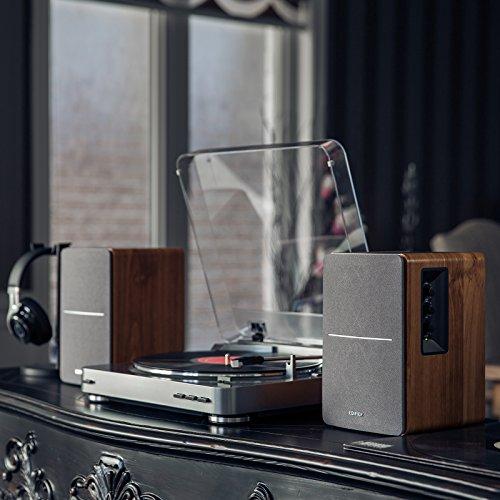
For vinyl enthusiasts, the analog inputs and warm sound signature create natural synergy with turntables. The speakers connect directly to turntables with built-in preamps, or through external phono preamps for vintage turntables. Multiple users noted that the slightly relaxed high-frequency response complements the natural warmth of vinyl playback.
Gaming applications receive mixed feedback. The clear midrange benefits dialogue and atmospheric audio, but the limited bass extension means some modern games' low-frequency effects don't achieve full impact. For competitive gaming where positional audio matters most, the speakers perform adequately, though dedicated gaming headphones typically offer superior spatial precision.
Regarding home theater use, the Edifier R1280T faces natural limitations. While they work for casual movie watching in small rooms, they lack the dynamic range, bass extension, and multi-channel capabilities that serious home theater demands. The absence of a dedicated center channel means dialogue can sometimes get lost in complex soundtracks, and action sequences won't deliver the visceral impact that larger systems provide.
At the time of writing, the R1280T competes in a market segment that includes both significantly cheaper computer speakers and more expensive audiophile-oriented alternatives. User experiences suggest the speakers deliver performance that clearly surpasses typical computer speakers while remaining accessible to users not ready for high-end audio investments.
The value proposition becomes particularly compelling when you consider the total system cost. Unlike passive speakers, there's no need to purchase a separate amplifier, and the included cables handle most connection scenarios out of the box.
The Edifier R1280T succeeds by focusing on fundamental audio quality rather than chasing the latest technological trends. For users seeking their first taste of serious audio reproduction, or anyone needing reliable powered speakers for desktop or small room use, these speakers deliver performance that consistently exceeds expectations.
The limitations are real—no wireless connectivity, modest bass extension, and simple features—but they don't undermine the core mission of reproducing music with clarity and enjoyment. In a market increasingly focused on convenience over quality, the R1280T stands as a reminder that sometimes the best approach is simply doing the basics exceptionally well.
Whether you're upgrading from built-in laptop speakers or building your first vinyl setup, these speakers offer a compelling entry point into better audio that should satisfy for years to come.
No, the Edifier R1280T speakers are powered (active) speakers with a built-in 42W RMS amplifier. You can connect them directly to your TV, computer, turntable, or any audio source without needing a separate amplifier or receiver.
The Edifier R1280T can work for basic home theater setups in small rooms, but they have limitations. They're best suited for casual movie watching rather than serious home theater use. They lack a center channel for dialogue clarity, have limited bass extension for action scenes, and don't support surround sound formats.
The speakers feature dual RCA inputs, allowing you to connect two devices simultaneously. You can connect TVs, computers, turntables with built-in preamps, gaming consoles, phones (with RCA adapter), and CD players. However, the Edifier R1280T doesn't have Bluetooth or digital inputs.
The 4-inch woofers and rear ports provide decent bass for their size, with frequency response down to 75Hz. They deliver punchy mid-bass suitable for most music and dialogue, but lack deep sub-bass extension. For home theater with impactful explosions and rumble, you'd need to add a separate subwoofer.
The Edifier R1280T speakers work best in small to medium rooms up to about 150-200 square feet. They're ideal for bedrooms, offices, or small living rooms. For larger home theater rooms, you'd need speakers with more power and larger drivers.
No, the Edifier R1280T speakers are wired-only with analog RCA inputs. They don't have Bluetooth, Wi-Fi, or any wireless connectivity options. If you need Bluetooth, consider the Edifier R1280DB or R1700BT models instead.
Yes, the active speaker features side-mounted bass and treble controls with ±6dB adjustment range, plus a master volume knob. The included wireless remote provides convenient volume and mute control from your listening position.
The Edifier R1280T typically offers better stereo separation and midrange clarity than budget soundbars, making dialogue clearer. However, soundbars usually provide wider soundstages and often include dedicated center channels for better dialogue reproduction in movies.
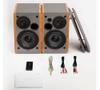
The package includes all necessary cables: RCA to RCA cable, 3.5mm to RCA adapter cable, and the speaker wire connecting the active and passive speakers. You can connect most audio sources right out of the box.
Yes, the Edifier R1280T offers excellent value for users seeking quality desktop or small room audio. They provide significant sound quality improvements over computer speakers and basic TV audio, with solid build quality and convenient features. However, for dedicated home theater use, consider speakers with more power, larger drivers, and surround sound capabilities.
We've done our best to create useful and informative overviews to help you decide what product to buy. Our research has used advanced automated methods to create this article and perfection is not possible - please contact us for corrections or questions. These are the sites we've researched in the creation of this article: bestbuy.com - kbaudio.co.uk - everydaylistening.net - hometechnologyreview.com - soundguys.com - recordbuilds.com - audiosciencereview.com - edifier-online.com - youtube.com - audiosciencereview.com - tomsguide.com - youtube.com - youtube.com - audiosciencereview.com - hometechnologyreview.com - edifier.com - audiostance.com - usa-oss.edifier.com - edifier-online.com - edifier.com - youtube.com - edifier.com - bestbuy.com - audiosciencereview.com - kbaudio.co.uk - officedepot.com
| Edifier R1280T |
|---|
| Total Power Output - Determines maximum volume and dynamic range: 42W RMS (21W per channel) |
| Driver Configuration - Core component affecting sound quality: 4-inch woofer + 13mm silk dome tweeter |
| Amplifier Type - Built-in Class-D provides efficiency and low heat: Integrated powered design |
| Input Options - Allows multiple simultaneous connections: Dual RCA line inputs |
| Frequency Response - Shows audio range the speakers can reproduce: 75 Hz – 18 kHz |
| Signal-to-Noise Ratio - Higher numbers mean cleaner sound with less background noise: ≥ 85 dBA |
| Distortion - Lower percentages indicate cleaner audio reproduction: ≤ 0.5% |
| Tone Controls - Lets you adjust sound to your room and preferences: Bass and treble adjustment (±6dB) |
| Cabinet Material - MDF reduces unwanted vibrations vs plastic alternatives: MDF wood construction |
| Connectivity - No Bluetooth or digital inputs: Analog RCA only |
| Remote Control: Volume and mute functions |
| Dimensions: 5.75" W × 9.5" H × 7" D |
| Weight: 4.9 kg net |
| Power Supply: Universal 100-240V AC |
The Logitech Z207 takes a completely different approach, prioritizing wireless convenience and modern connectivity over pure audio performance. Its standout feature is Bluetooth 4.2 with Easy-Switch technology, allowing you to pair two devices simultaneously and seamlessly switch between them - incredibly useful for users who regularly jump between phones, laptops, and tablets throughout the day. The compact 3.54" x 9.49" x 4.88" footprint and 2.2-pound total weight make it ideal for space-constrained environments like dorm rooms or cluttered desks where the R1280T's substantial presence wouldn't fit. The built-in headphone jack adds practical value for video calls and private listening, while the wireless connectivity eliminates cable management entirely.
However, the Logitech Z207's 5W RMS power output and limited 120Hz-20kHz frequency response reveal the compromises made for convenience. Where the R1280T fills rooms with robust, warm sound, the Z207 works best as a near-field desktop solution, lacking the bass depth and power needed for immersive music listening or movie watching. At roughly half the R1280T's typical price, it offers excellent value for users who prioritize wireless functionality and device switching over audio fidelity, but those seeking genuine sound quality improvement over basic computer speakers will find the Z207's performance limitations frustrating. The choice ultimately comes down to whether you value the R1280T's superior audio performance or the Z207's modern wireless convenience - they're solving fundamentally different problems for different types of users.
🤖 Read Detailed Comparison
👌Logitech Z207 Bluetooth Computer Speakers Details
💵 See Logitech Z207 Bluetooth Computer Speakers Price
The Kanto ORA takes a fundamentally different approach with its reference-grade accuracy and modern connectivity suite. Where the R1280T prioritizes warmth and immediate appeal, the ORA delivers clinical precision through bi-amplified Class D power and DSP tuning that achieves an exceptionally flat frequency response within ±2dB across most of the audible spectrum. This technical sophistication translates to superior imaging and detail retrieval, making the ORA significantly better for content creation, critical listening, and professional applications where accuracy matters more than musicality. The compact 3.9" x 6.9" x 5.6" footprint is also dramatically smaller, fitting easily under monitors or in cramped desk setups where the R1280T simply won't work.
However, this precision comes at roughly double the cost and requires different expectations from users. The Kanto ORA's 3-inch woofers deliver less bass impact than the R1280T's 4-inch drivers, making a subwoofer almost mandatory for full-range music enjoyment – though the dedicated sub output with automatic crossover makes integration seamless. The neutral tuning can sound clinical or unengaging compared to the R1280T's warm character, and features like USB-C high-resolution audio and Bluetooth 5.0, while technologically superior, may be overkill for users who simply want better sound from their computer. For most casual listeners, the R1280T's combination of engaging sound, simplicity, and value remains more compelling, but the ORA justifies its premium for users who prioritize accuracy, space efficiency, and modern connectivity over immediate musical gratification.
🤖 Read Detailed Comparison
👌Kanto ORA Powered Reference Desktop Speakers Pair Details
💵 See Kanto ORA Powered Reference Desktop Speakers Pair Price
The Creative Pebble V2 takes a completely different approach to desktop audio, prioritizing space efficiency and convenience over raw performance. These compact spherical speakers deliver surprisingly good sound from their tiny 4.5-inch footprint, using clever engineering like passive radiators and 45-degree angled drivers to maximize their 2-inch full-range drivers. The USB-powered design eliminates the need for wall outlets and reduces cable clutter to just two connections, making them ideal for minimalist setups, dorm rooms, or frequently rearranged workspaces. At roughly one-third the cost of the R1280T, the Pebble V2 represents exceptional value for users upgrading from built-in laptop or monitor speakers, delivering clear vocals and impressive bass considering the physical constraints.
However, the performance gap between these approaches is substantial. The Creative Pebble V2's 8W total power output and 100Hz-17kHz frequency response simply cannot match the R1280T's room-filling capabilities and deeper bass extension. While the Pebbles excel at near-field desktop listening and casual content consumption, they struggle with dynamic music, lack the power for any home theater applications, and offer no tone controls or multiple inputs. The choice ultimately comes down to priorities: the Pebble V2 maximizes convenience and value for basic desktop audio needs, while the R1280T provides genuine audiophile performance for users willing to invest in superior sound quality and accept the larger footprint.
🤖 Read Detailed Comparison
👌Creative Pebble V2 Desktop Speakers Details
💵 See Creative Pebble V2 Desktop Speakers Price
The PreSonus Eris 3.5 takes a fundamentally different approach as a true studio monitor, prioritizing accuracy over entertainment value. While it uses smaller 3.5-inch drivers that can't match the R1280T's bass extension, the Eris 3.5 delivers 50 watts of Class AB amplification compared to the Edifier's 42 watts, providing better headroom and cleaner sound at higher volumes. The real standout features lie in its professional connectivity – balanced 1/4-inch TRS inputs, unbalanced RCA, and a front-panel auxiliary input with integrated headphone amplifier that automatically mutes the speakers. The rear-mounted acoustic tuning controls (±6dB at 100Hz and 10kHz) allow precise room correction without encouraging casual adjustment that could compromise the reference sound quality.
In real-world use, the PreSonus Eris 3.5 excels where the R1280T falls short – content creation, critical listening, and professional applications. Its neutral frequency response reveals details in music and audio that the Edifier's warmer tuning might mask, making it invaluable for video editing, podcasting, or mixing. The compact form factor suits smaller desks better, while the multiple input options eliminate the need for audio switching. Though it sacrifices the immediate bass impact and musical warmth that makes the R1280T so engaging for entertainment, the Eris 3.5 offers superior long-term value for users who might grow into audio production work or simply want to hear their music exactly as intended rather than artificially enhanced.
🤖 Read Detailed Comparison
👌PreSonus Eris 3.5 Studio Monitors Pair Details
💵 See PreSonus Eris 3.5 Studio Monitors Pair Price
The Klipsch Reference R-41PM takes a dramatically different approach with premium features and significantly higher power output that justifies its substantially higher price point. With 70W RMS total amplification and Klipsch's signature horn-loaded tweeter design, these speakers can fill medium to large rooms with authority while maintaining exceptional clarity and detail retrieval. The extensive connectivity options—including Bluetooth with aptX, USB audio supporting 24-bit/96kHz high-resolution files, optical digital input, and a built-in phono preamp—eliminate the need for additional equipment and provide genuine versatility for modern listening habits. The dedicated subwoofer output offers a clear upgrade path for users who eventually want deeper bass extension, while the Dynamic Bass EQ automatically adjusts low frequencies based on volume level to maintain fullness at any listening level.
While the Klipsch R-41PM costs roughly double the price, it delivers professional-grade features and room-filling performance that the R1280T simply cannot match. The bright, forward sound signature excels in home theater applications where dialogue clarity is crucial, and the higher power output handles dynamic movie soundtracks without compression or distortion. However, some listeners may find the horn-loaded presentation too aggressive for casual background listening, and the larger footprint at over 11 inches tall may not suit compact desktop setups as well. The lack of physical controls means you're entirely dependent on the remote, which can be inconvenient for quick adjustments. For users who need the connectivity, power, and dynamic capabilities for larger rooms or home theater use, the R-41PM represents solid value despite the premium price—but those satisfied with the R1280T's warm, simple approach may find the additional features unnecessary for their needs.
🤖 Read Detailed Comparison
👌Klipsch Reference R-41PM Powered Bookshelf Speakers Pair Details
💵 See Klipsch Reference R-41PM Powered Bookshelf Speakers Pair Price
The Edifier R980T serves as Edifier's budget-conscious entry point into powered bookshelf speakers, offering the same fundamental design philosophy and build quality as the R1280T at a significantly lower price point. Its primary advantage lies in accessibility – providing a meaningful upgrade from basic computer speakers without requiring a substantial financial commitment. The R980T maintains the same high-quality silk dome tweeter technology and MDF wooden construction, ensuring pleasant, listenable sound that clearly outperforms typical plastic desktop speakers. For users with very limited budgets or minimal space requirements, such as small dorm rooms or cramped office setups, the R980T delivers competent performance with dual RCA inputs and adequate volume for near-field listening.
However, the R980T's limitations become apparent when compared directly to the R1280T's enhanced capabilities. With only 24W RMS total power output, it lacks the headroom for dynamic content and struggles to fill anything larger than very small spaces. The rear-mounted controls prove frustrating for daily use, requiring users to reach around or move the speakers for simple adjustments, while the absence of treble control eliminates fine-tuning options. Most significantly, the R980T delivers noticeably less clarity, detail, and bass depth, resulting in a more compressed, less engaging listening experience. While it represents solid value at its price point and successfully introduces users to the benefits of powered bookshelf speakers, the modest savings come with meaningful compromises in sound quality, convenience, and long-term satisfaction that make it primarily suitable for buyers with strict budget constraints rather than those seeking the best overall value.
🤖 Read Detailed Comparison
👌Edifier R980T Bookshelf Speakers Pair Details
💵 See Edifier R980T Bookshelf Speakers Pair Price
Original price was: $499.99.$369.99Current price is: $369.99.
Original price was: $579.99.$318.99Current price is: $318.99.


Privacy Policy
Terms and Conditions - Affiliate Policy
Home Security
© Copyright 2008-2026.
11816 Inwood Rd #1211, Dallas, TX 75244