

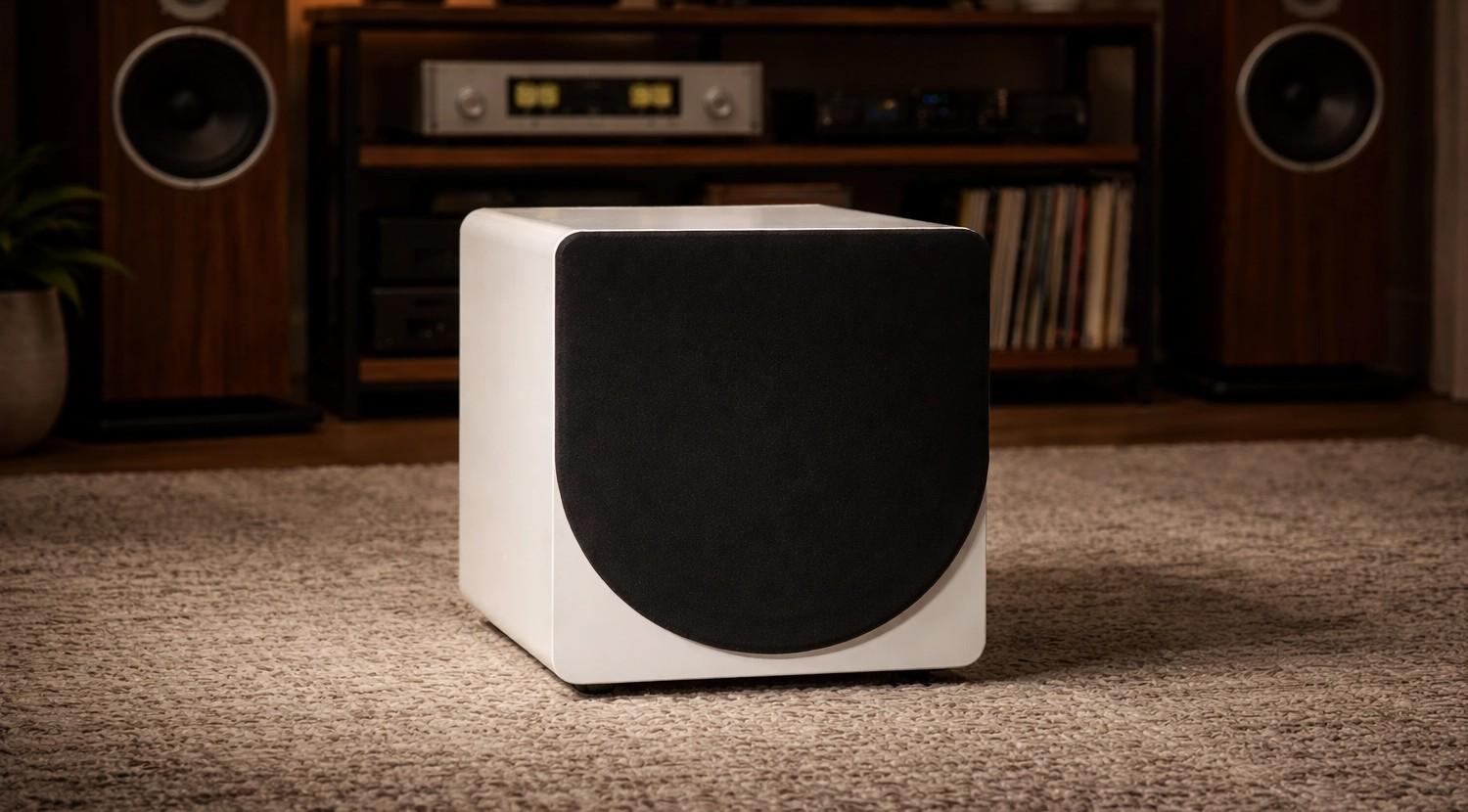
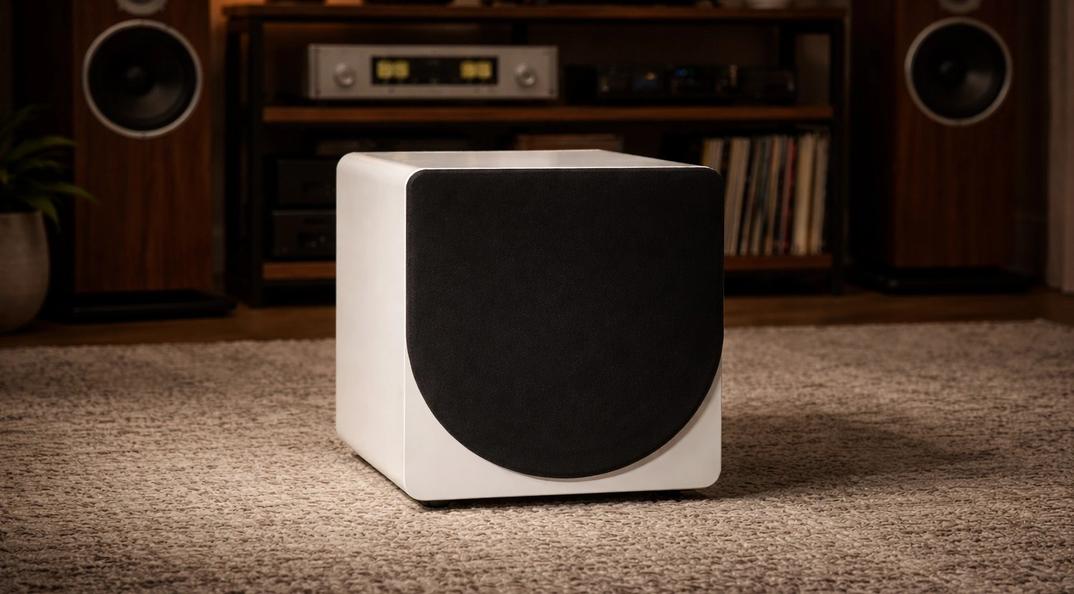
PS Audio is best known for electronics like DACs, streamers, and power gear. Now it’s stepping into a new category with its first-ever subwoofer: the Foundry F12, a sealed 12-inch model with built-in DSP room correction, app control, and a price tag of $2,749.
If you’ve shopped for subwoofers before, you know the basic pitch is usually the same: “go lower, hit harder.” The F12 takes a different angle. Rather than trying to win on raw output or eye-catching specs alone, PS Audio is framing this as a tool for getting predictable, controlled bass in normal living rooms and dedicated theaters alike.
One of the core ideas behind the Foundry F12 is that room acoustics dominate low-frequency performance. Below roughly 200 Hz, what you hear isn’t just the subwoofer; it’s the subwoofer plus your room’s dimensions, wall construction, and seating position.
That’s why you can move a sub a foot to the left and suddenly the bass either vanishes or booms. PS Audio is leaning into that reality instead of pretending the box is all that matters.
To tackle this, the F12 combines:
None of those elements are unusual by themselves, but together they point toward a clear goal: make bass easier to integrate, more consistent around the room, and less about brute force.
“Designer Chris Brunhaver and I have been working on an ultimate-quality subwoofer for a long time,” said Paul McGowan, PS Audio CEO. “The Foundry F12 is the logical complement to our Aspen series loudspeakers – or any high-quality speaker. With the Foundry F12, reference-quality bass is not limited by room size, placement constraints, or compromise, and the built-in DSP room correction makes it easy to achieve accurate in-room low-frequency response.”
Let’s talk hardware.
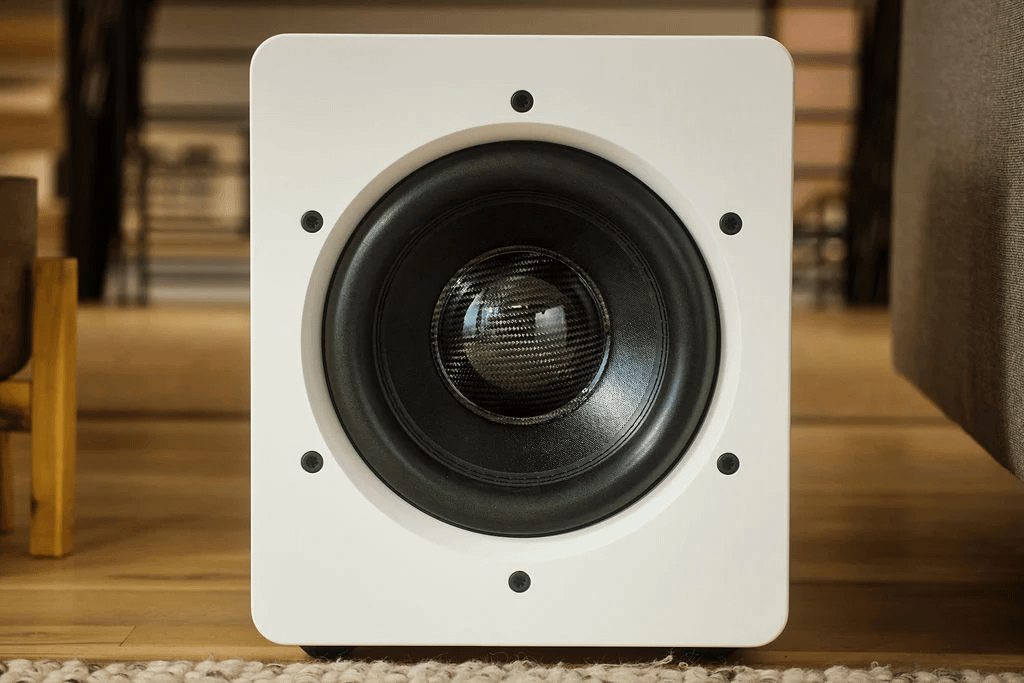
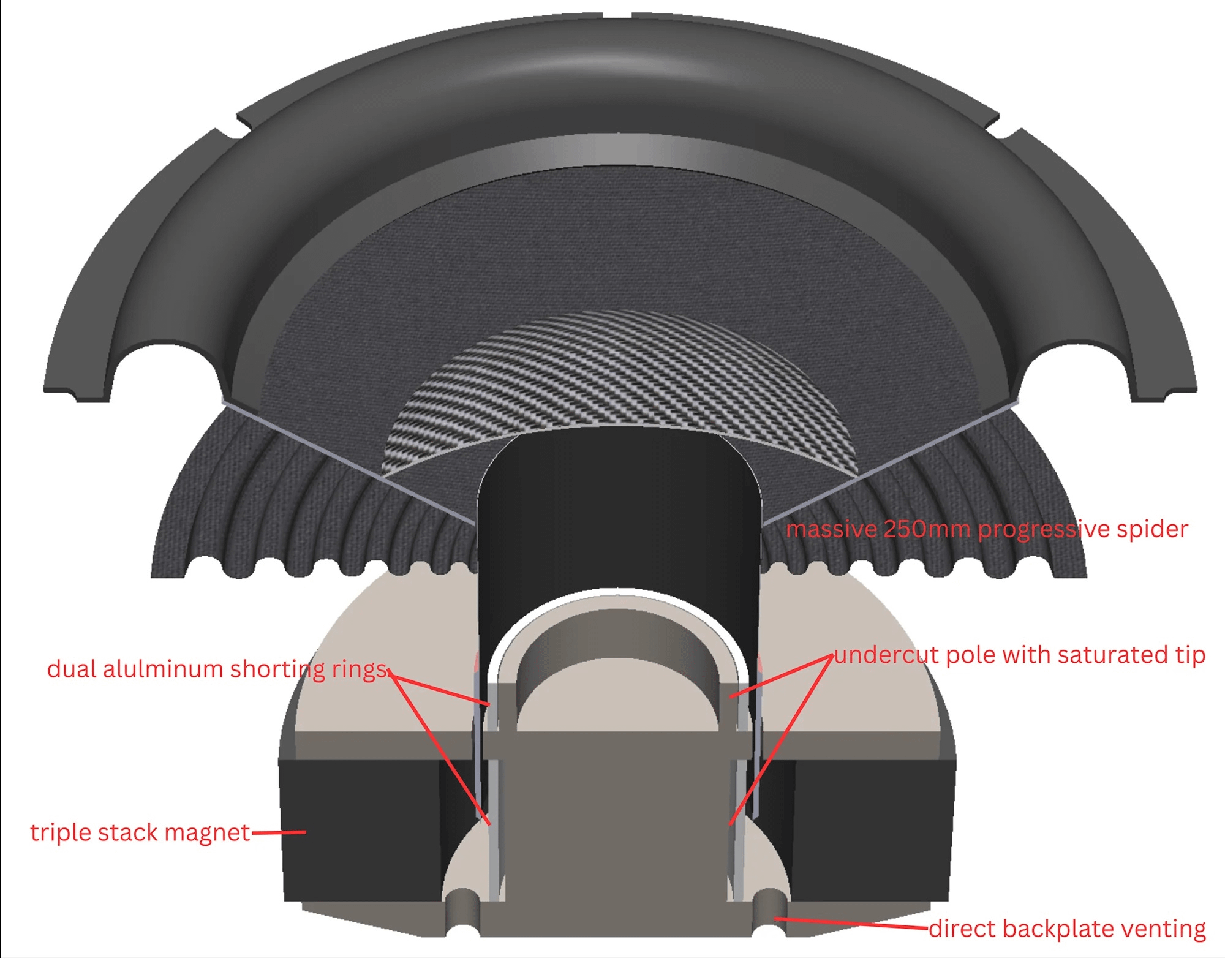
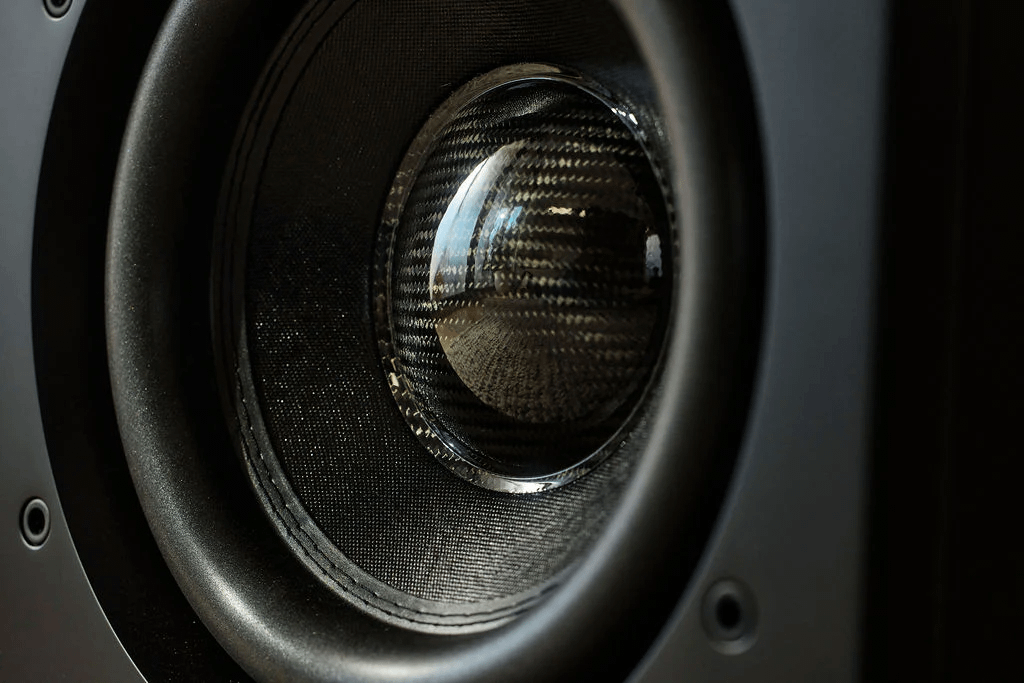
The Foundry F12 uses a newly designed 12-inch woofer built specifically for this sub. It’s a long-throw driver with more than 2.5 inches of excursion, supported by a large 10-inch graduated Nomex spider. The motor structure includes large magnets and dual shorting rings to help keep the magnetic field stable as the cone moves back and forth.
The cone itself is paper, paired with a carbon-fiber dust cap. That combination is chosen to keep the moving mass relatively low while maintaining stiffness and internal damping — in plain language, it’s designed to move a lot of air without flexing or ringing in ways that smear detail.
Driving all of that is a 1,000-watt continuous high-current amplifier, backed by a 1,800-watt power supply. PS Audio rates the F12’s maximum output at 113 dB at 2 meters, which is more than enough to get into “neighbors are texting” territory in many rooms, but the stated priority is control and linear behavior, not just how loud it can go.
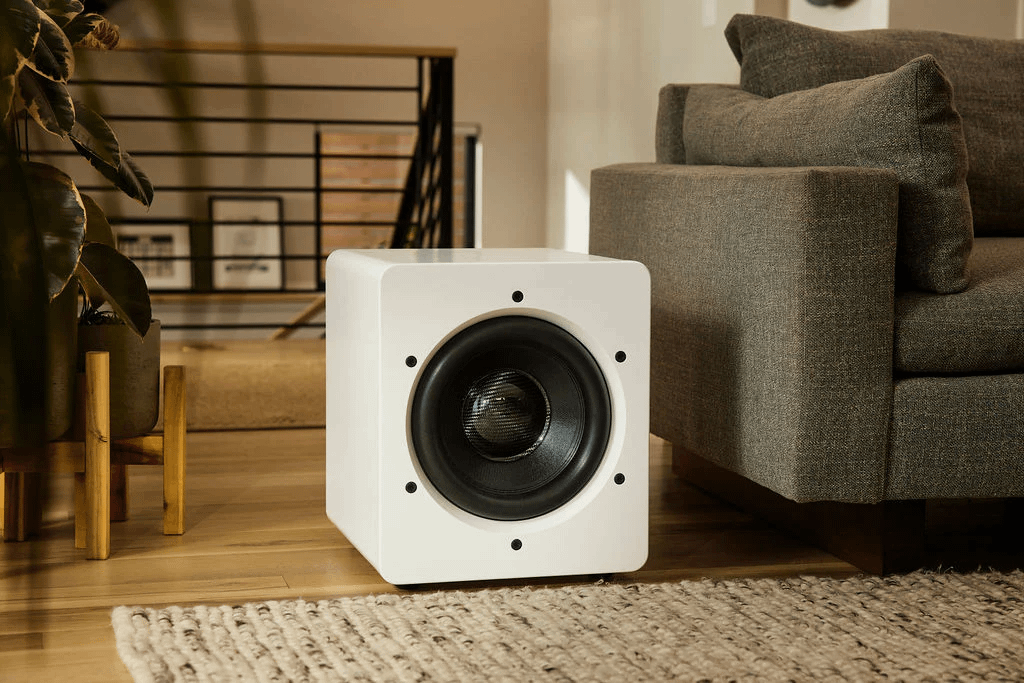
The sealed cabinet plays into that same theme. Instead of using a port to boost output in a narrow frequency band, the F12 relies on its driver, amp, and DSP to reach low frequencies. PS Audio specifies the response as –6 dB at 20 Hz anechoic (ground-plane), with typical in-room response extending flat to below 20 Hz thanks to room gain. Across its operating range, it’s rated at ±0.5 dB up to 500 Hz, which suggests the tuning is aimed at consistency rather than a “smiley-face” curve.
If you’ve ever fought with boomy or uneven bass, this is probably the most relevant part for you.
The Foundry F12 includes onboard DSP that handles crossover behavior, delay, EQ, and overall tonal balance. Instead of forcing you to dig through tiny rear-panel knobs and switches, PS Audio pushes most of the control into the Foundry control app for iOS and Android.
From the app, you can:
There’s also an auto-EQ mode. Here’s the interesting part:
you don’t need an external measurement microphone. You sit at your listening position, point your phone, and the app uses the phone’s mic to measure how the sub interacts with your room. It then generates EQ to address common problems like:
Is this going to replace a full-scale professional calibration with dedicated tools? No. But for many users, having built-in, phone-based measurement and correction is a big step up from guessing and hoping.
If you’d rather stay hands-on, the manual controls and presets give you enough flexibility to experiment and dial things in yourself.
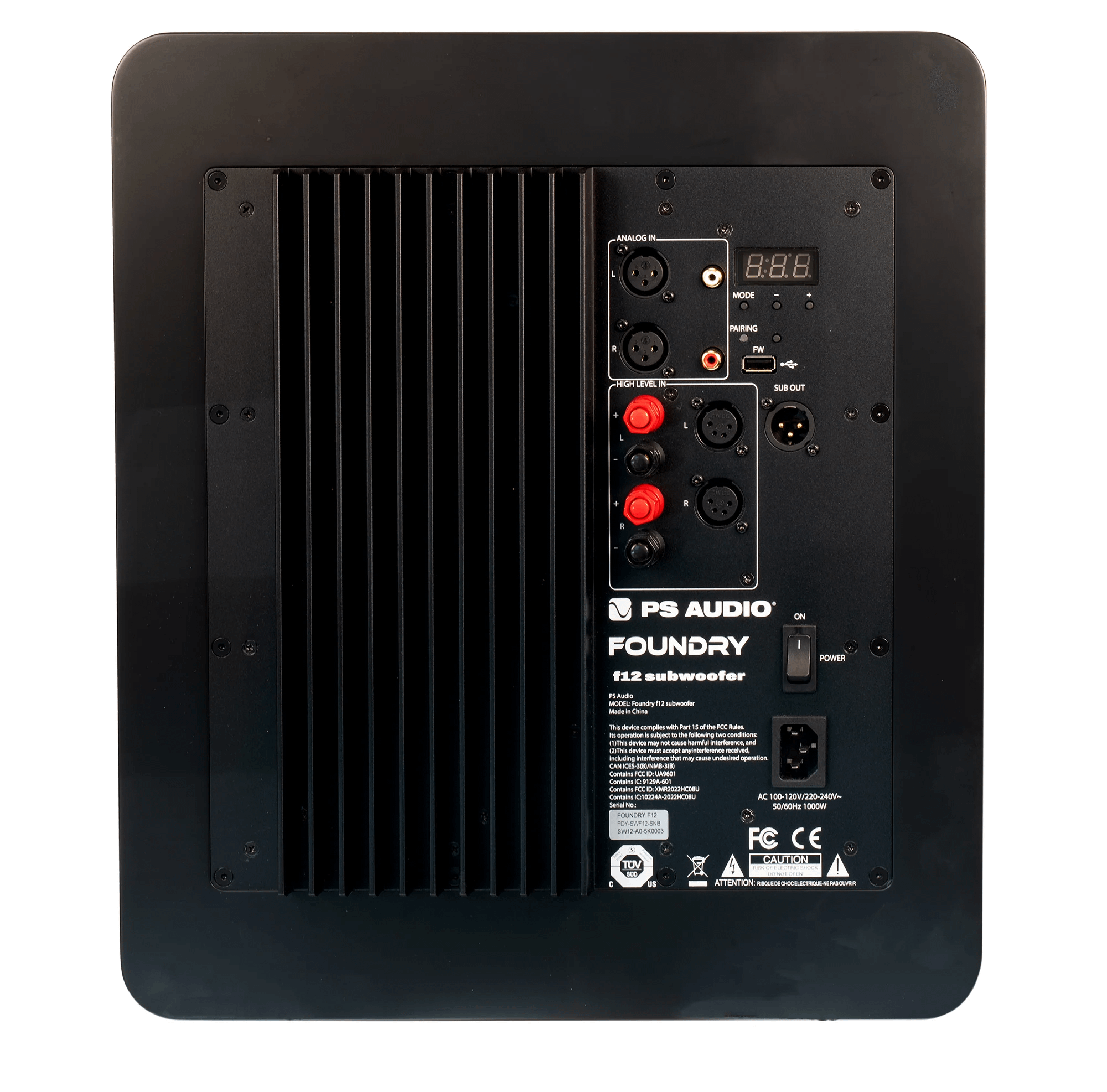
The Foundry F12 is designed to work in both traditional hi-fi systems and home theater setups, with a wide range of input options:
That means you can integrate it with a stereo preamp that only has RCA outputs, a balanced preamp, or even a power amp with no dedicated subwoofer output. You don’t need extra boxes or adapters just to get a signal to the sub.
If you’d prefer not to run a long cable across the room, PS Audio offers an optional WiSA transmitter for $199. Using WiSA E 24/96 wireless, it’s designed for low latency and high-quality transmission. A single transmitter can talk to ten or more subwoofers, though each one needs its own receiver.
For more complex systems, the F12 includes a dedicated subwoofer output on each unit. That lets you daisy-chain multiple F12s without an external splitter or processor. If you’re trying to smooth bass across several seats or a large room, spreading two or more subs around the space is often more effective than just buying one bigger sub, and PS Audio is clearly acknowledging that reality.
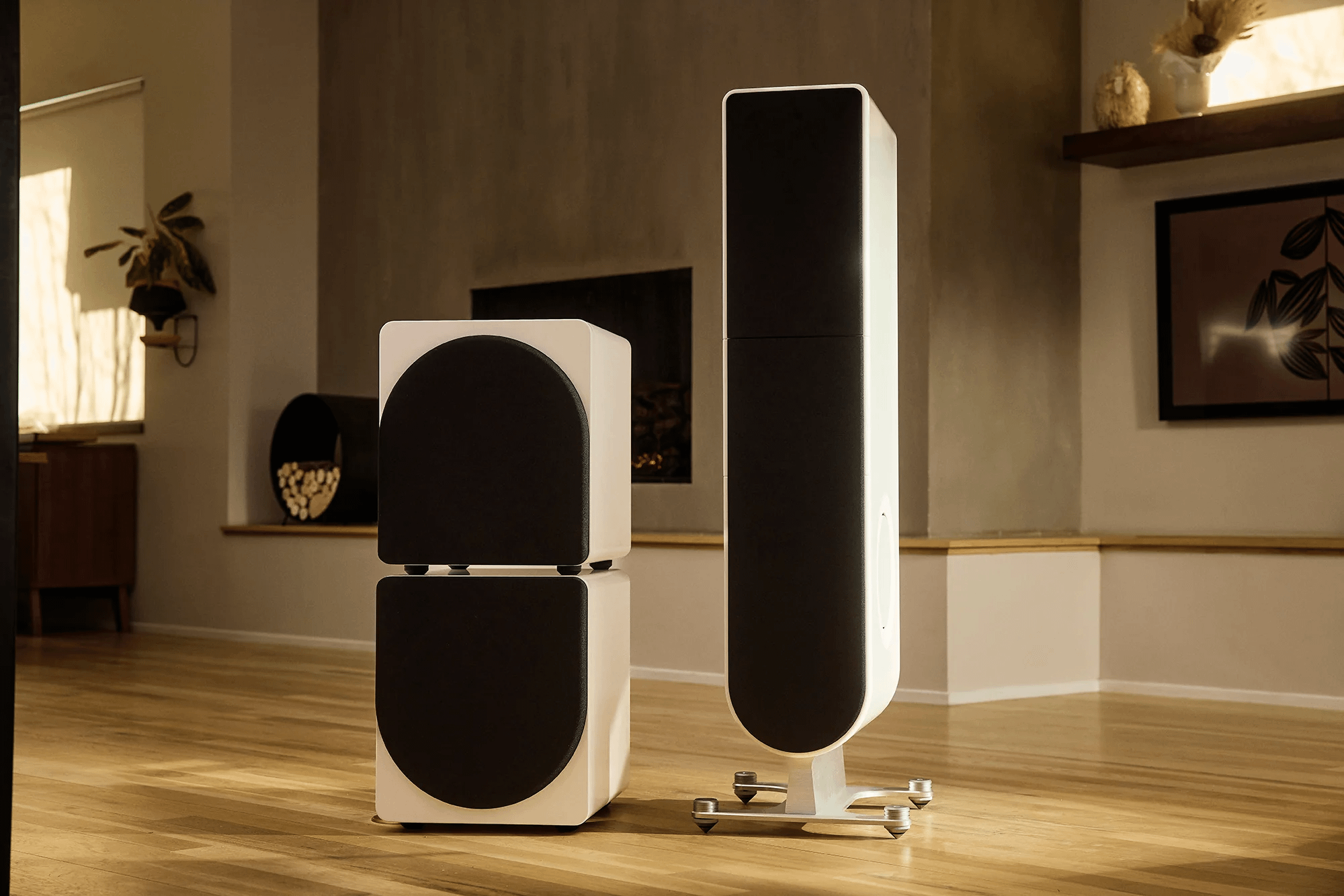
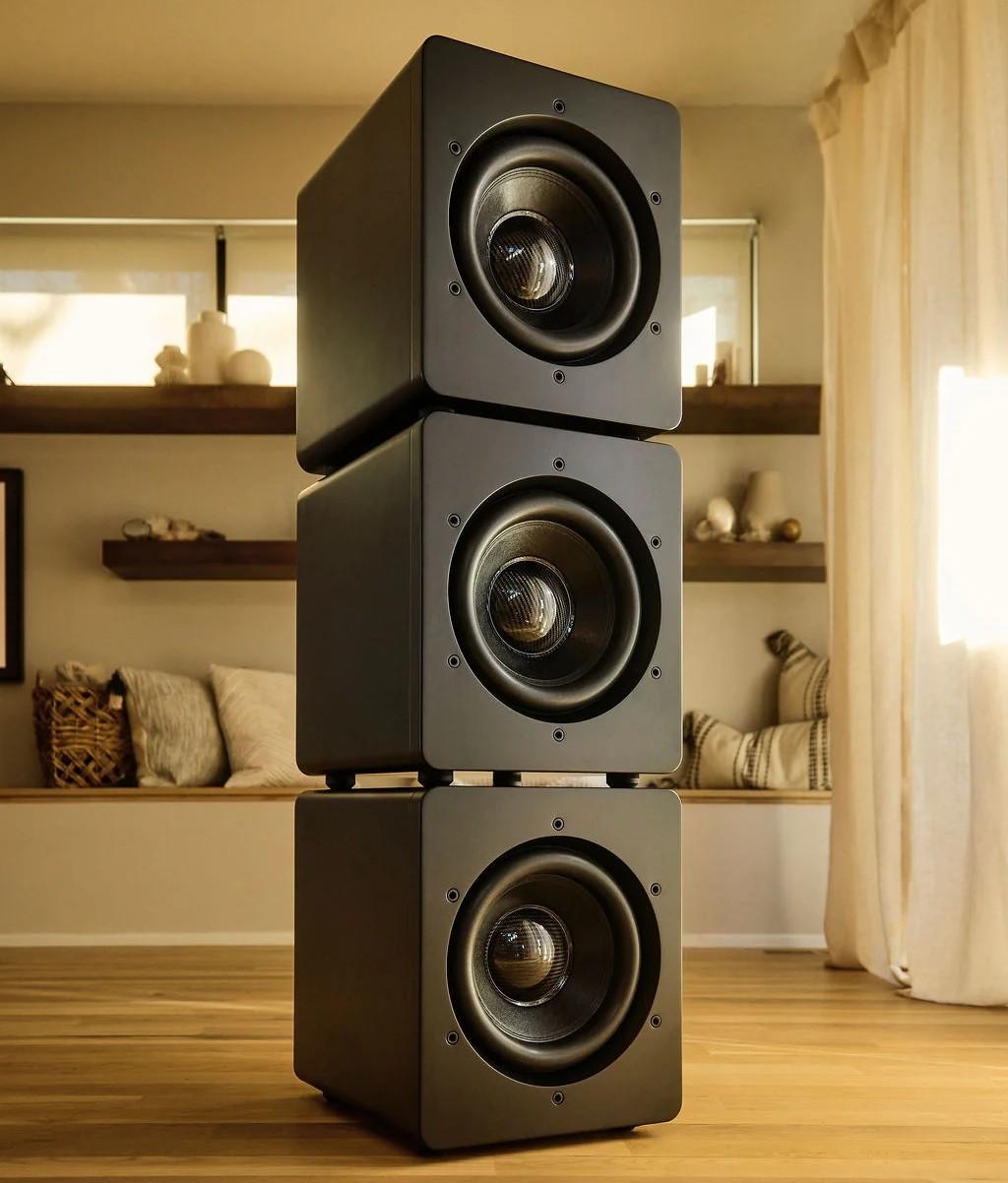
The company also sells an optional stacking kit for $99 per pair of subs. It lets you safely stack two or three F12s vertically, with the necessary mechanical hardware and cabling included. Stacking isn’t the only way to deploy multiple subs, but it can be handy in rooms where floor space is limited.
On the practical side, the Foundry F12 is relatively compact for a high-output sealed 12-inch design, but it’s not small in absolute terms.
PS Audio lists the dimensions at roughly:
Weight comes in at around 77 pounds (35 kg), so this is very much a “plan your placement before unboxing” kind of product.
You can get it in satin black or satin white, which should cover most living rooms and dedicated theaters. The enclosure is sealed, so you don’t have to worry about rear ports needing extra breathing room from the wall.
With a $2,749 price tag, the Foundry F12 doesn’t sit in the budget category. It enters a competitive field that already includes sealed models from brands like SVS (particularly SB-5000 R|Evolution and SB17-Ultra R|Evolution), REL, and MartinLogan, some of which cost a bit less and some considerably more. There are alternatives that prioritize maximum output per dollar, and there are models that lean more heavily into luxury design or brand cachet.
PS Audio’s angle here is different:
On paper, the Foundry F12 looks like it’s aimed at people who already care about integration and room behavior, listeners who have invested in capable speakers, understand that bass is mostly a room problem, and want tools to manage that without turning their living room into a lab.
Whether PS Audio eventually builds a full Foundry lineup at different sizes and price points remains to be seen. For now, the F12 is a single, focused entry that shows how the company thinks low-frequency reproduction should be handled: not as a stunt, but as a controllable part of the system that can be tuned to the space you actually live in.
Related Reading:



Privacy Policy
Terms and Conditions - Affiliate Policy
Home Security
© Copyright 2008-2026.
11816 Inwood Rd #1211, Dallas, TX 75244