

This editorial reflects a simple, unapologetic opinion formed after years of reviewing, installing, and living with home theater systems: if you upgrade one thing before the Super Bowl, it should be screen size.
Every Super Bowl, the same questions show up like clockwork. Is this the year to upgrade? Is OLED finally worth it? Should I fix the audio first? Is my TV still good enough? Here's the honest answer most people in this industry dodge because it kills the upsell: If you do one thing before the Super Bowl, make your TV bigger. Not better on paper. Not more accurate in some labs. Just bigger.
When a client calls me about the Super Bowl, it's rarely about picture quality or HDR performance. It's about one thing: "GET ME A BIGGER TV HERE ASAP." They've been to someone's house. They've seen the game on a proper-sized screen. And now their 55-inch feels like watching football through a porthole.
That's where the big game lives—on a bigger TV. These aren't tech nerds calling. They're regular people who finally understand what they've been missing. The urgency in their voice says everything: screen size isn't a luxury specification. It's the difference between watching the Super Bowl and experiencing it.
The Super Bowl isn't a normal broadcast. It's designed—deliberately—to hit you over the head. Wide shots that capture the scale of a packed stadium. Tight facial close-ups that show every emotion. Rapid camera cuts that follow the action across 100 yards. Cinematic halftime productions with pyrotechnics, coordinated dancers, and stage setups that cost more than most people's houses.
All of that dies on a small screen.
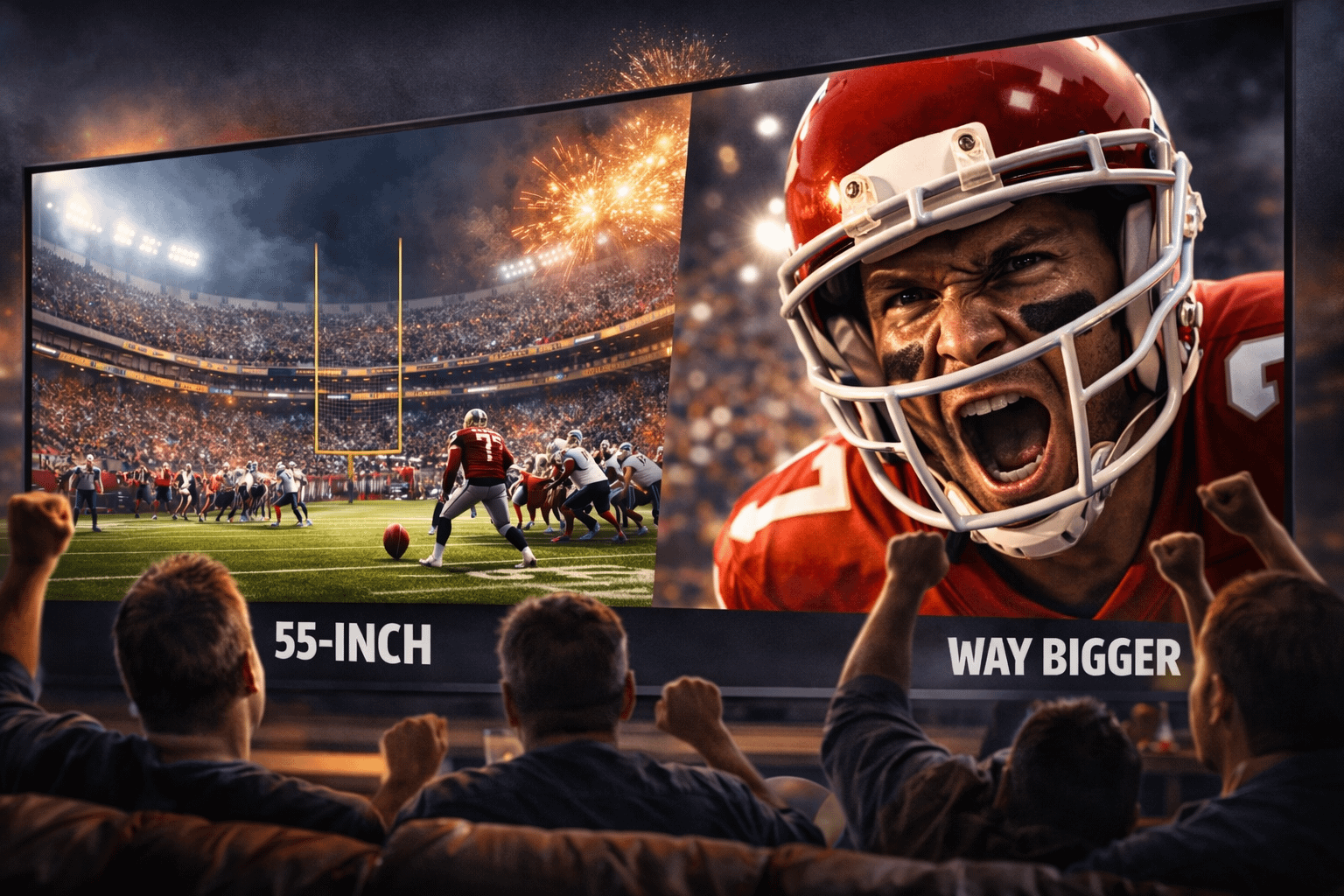
Immersion doesn't come from contrast ratios or processing buzzwords. It comes from field of view. The more of your vision the screen fills, the more real it feels. This is basic human perception, not marketing fairy dust. Think about the last time you went to a movie theater. The screen wasn't just bigger—it consumed your field of view. Your peripheral vision disappeared into the image. That's what creates the "you're there" feeling. That's what makes moments land.
A larger screen delivers:
Greater scale. When the camera pulls back for a field goal attempt, you see the entire stadium. The kicker. The holder. The line. The opposing rush. It looks like an actual football field, not a tabletop game.
Stronger emotional punch. Close-ups of coaches screaming, players celebrating, fans losing their minds—these moments need physical presence. On a small screen, they're just faces. On a big screen, you feel the intensity. Better perceived detail, regardless of resolution. Here's something the spec sheets won't tell you: a 1080p image on a 75-inch screen often looks more detailed than a 4K image on a 50-inch screen. Your brain processes size and clarity together. Bigger creates the impression of sharper, even when the pixel count is identical. A more "you're actually there" experience. When the screen fills enough of your vision, your brain stops treating it like a window you're looking through and starts treating it like a space you're in. That shift is everything.
A smaller screen, no matter how refined, can't touch that. You can have perfect blacks, flawless motion handling, and color accuracy that would make a colorist weep—but if the image is small, the Super Bowl still feels like something happening far away that you're observing through a screen.
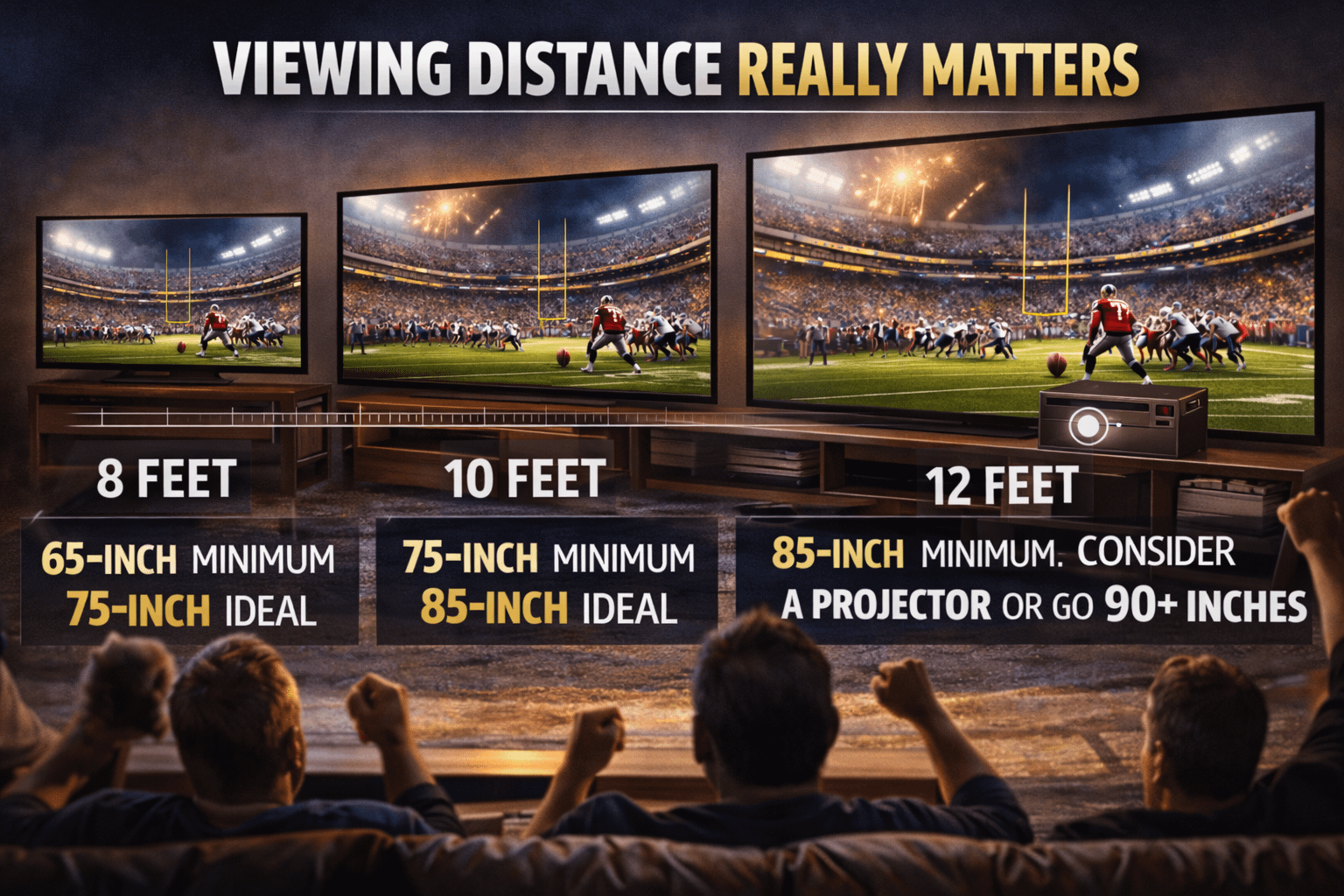
Here's a practical reality: viewing distance matters, but probably not how you think.
The industry loves to publish charts about "optimal viewing distance" based on screen size and resolution. They'll tell you that for a 55-inch 4K TV, you should sit 5.5 feet away. For a 65-inch, 6.5 feet. And so on. Forget those charts. Those recommendations are based on when you can no longer resolve individual pixels—when the image becomes perceptually "perfect." But that's not how people actually watch TV, and it's definitely not how you want to watch the Super Bowl. Most living rooms have the couch 8 to 12 feet from the TV. That's just how rooms are laid out. At that distance, here's what you actually need for the screen to feel immersive:
Can you "see" a 55-inch TV from 10 feet away? Sure. But will it feel big? Will it dominate your attention? Will the Super Bowl feel like an event?
No chance.
This isn't about brands. Samsung, LG, Sony, TCL, Hisense—pick one. There are no bad large TVs anymore, only different trade-offs. The gap between manufacturers has shrunk dramatically over the past five years, while the gap between screen sizes remains enormous. A mid-tier 75-inch TV will consistently feel more impressive than a flagship 55-inch model. That's not opinion—it's how visual immersion works.
Here's what actually matters when you're shopping:
Get the size your room can handle. Measure your wall. Measure your stand. Then buy the biggest TV that fits. Don't leave headroom "just in case." You won't regret using all the available space. Don't overthink the tech. QLED, OLED, Mini-LED—they all look good in a dark room watching sports. Yes, there are differences. No, those differences won't matter more than an extra 10 inches of screen.
Prioritize features you'll actually use. Does it have enough HDMI ports for your soundbar, game console, and cable box? Does the smart TV interface work smoothly? Can you actually read the menus from your couch? These practical details matter more than lab-tested color gamut. Consider last year's model. TV manufacturers release new models every spring. That means January and February are when last year's inventory gets cleared out. You can often find a 75-inch flagship from 2024 for the same price as a 65-inch mid-tier model from 2025. Same tech, bigger screen, better deal.
If you're choosing between bigger and better, choose bigger. Every time.
This will tick off some enthusiasts, but it needs saying:Audio upgrades are incremental. Screen size is transformational.A better soundbar or surround system will improve your experience. But it won't change the fundamental nature of how you watch the game. You can live with average sound for another season. Your brain adapts. It compensates. Dialogue remains clear enough. Crowd noise still rumbles.
What your brain cannot do is manufacture a visual scale that isn't there. Here's the difference: bad audio is annoying. A small screen is limiting. With mediocre sound, you still get the full game. You see every play. You catch every replay. You experience the visual spectacle of halftime. The emotional moments still land because you can see faces, read body language, and watch the action unfold.
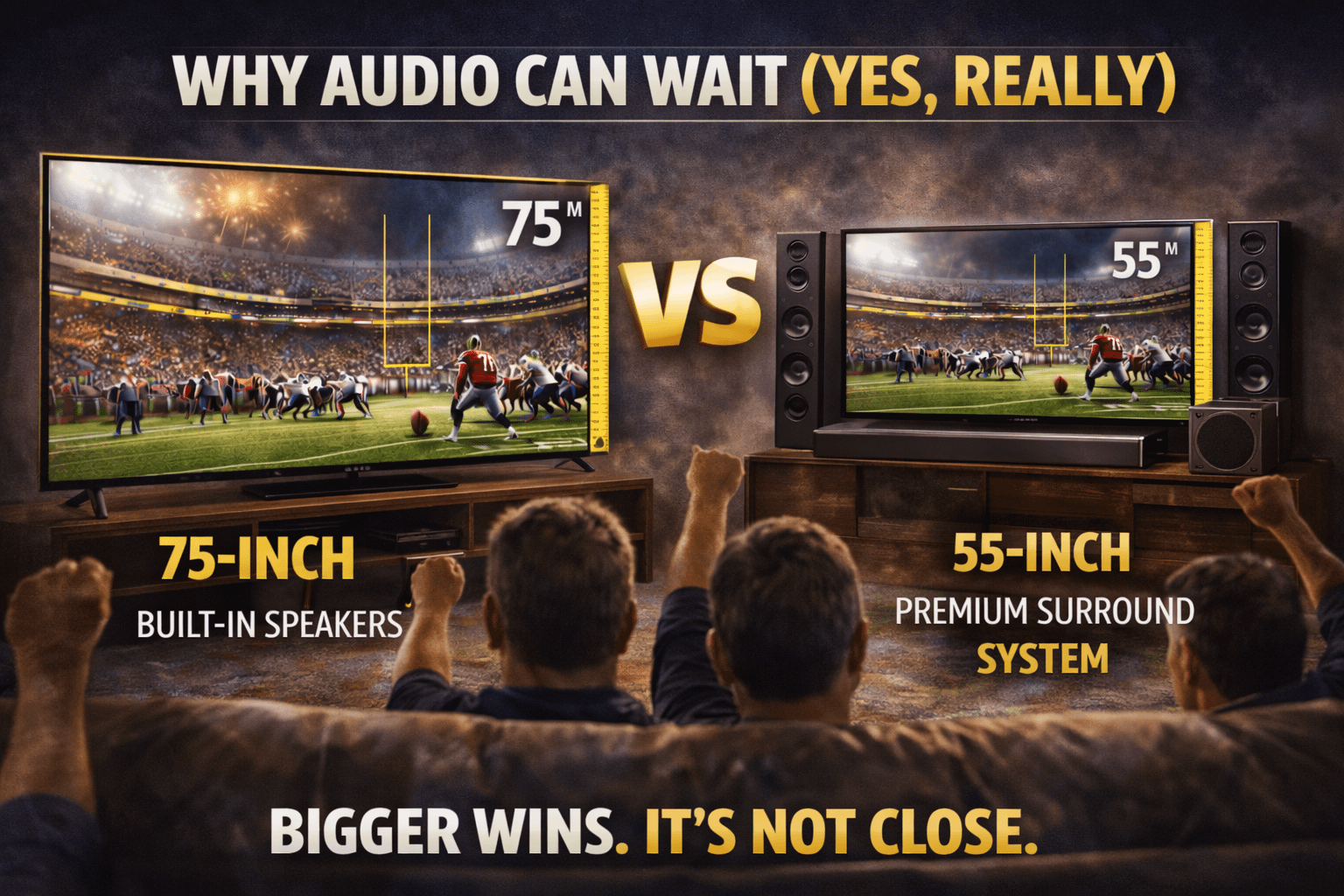
With a small screen, you're fighting for immersion from the opening kickoff. The commentary feels detached because the announcers' booth shots are tiny. Wide shots of the field look cramped. Halftime performances feel distant and flat. Even the commercials—which companies spend millions to produce—lose their impact when they're squeezed onto an undersized display. Put it this way: Would you rather watch the Super Bowl on a 75-inch TV with built-in speakers, or a 55-inch TV with a premium surround system?
The 75-inch wins. It's not close. Upgrade audio later. The Super Bowl is a visual event first, and it demands visual presence.
Here's the simplest test: People regret brands. People regret features. People regret overspending. Nobody regrets going bigger. Across thousands of installs, reviews, and conversations with clients, the most common takeaway isn't "I bought the wrong TV" or "I should have gotten OLED instead." It's "I should have gone larger."
I've had clients call me a week after installing a 65-inch TV asking if they can exchange it for a 75-inch. I've never had anyone call asking to go smaller. The Super Bowl has a way of making that crystal clear. You invite people over. Everyone's excited. The game starts. And then someone who has a bigger TV at home makes an offhand comment, and suddenly you're acutely aware that your screen isn't quite big enough.
Don't be that person this year.
This Sunday isn't about specifications, calibration charts, or chasing perfection. It's about impact.
The Super Bowl is one of the few events left that people actually watch live. No pausing. No scrolling on your phone. No second screen. You sit down with friends and family, and for three and a half hours, you're locked in. That communal experience deserves a screen that matches the moment. If you want the Super Bowl to feel like the event it is—if you want the game, the commercials, and the halftime show to actually land—if you want your guests to stop checking their phones and start reacting to what's happening—
Forget the debates. Stop overthinking the technology. Ignore the brand loyalists.
Buy a bigger TV.
Your Super Bowl party will thank you.
For advertising please contact the editor at [email protected]



Privacy Policy
Terms and Conditions - Affiliate Policy
Home Security
© Copyright 2008-2026.
11816 Inwood Rd #1211, Dallas, TX 75244