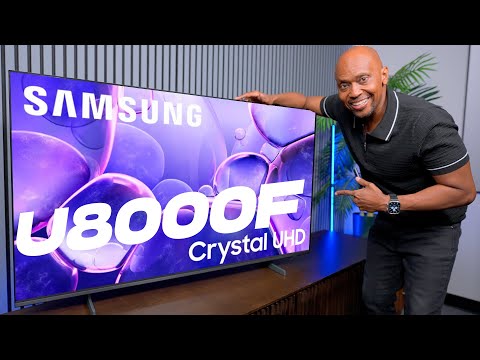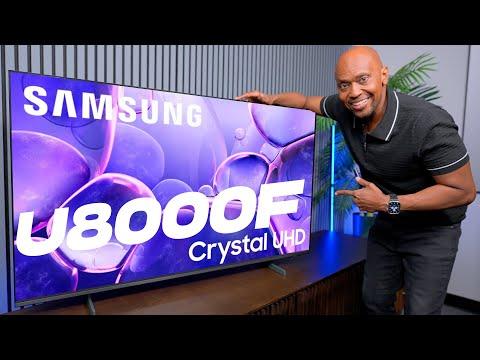
Samsung's latest entry-level 4K Crystal UHD offering brings familiar budget-friendly performance to the table, but in an increasingly competitive market where rival brands pack more premium features at similar price points. The U8000F continues Samsung's long-running 8000 series lineage with a few tweaks and, unfortunately, some feature removals. But does it strike the right balance of performance and affordability for 2025?
The Samsung U8000F represents the latest iteration in Samsung's entry-level 4K lineup, following a consistent naming pattern that tech enthusiasts have tracked for years: from the TU8000 (2020) to the AU8000 (2021), then the CU8000 (2023), the DU1000 (2024), and now this latest model.
"If you've been following me since 2020, I did an unboxing and setup and all that good stuff on the TU8000. Then we moved over to the AU8000. They skipped the BU8000 here in the United States, but then we continued on to the CU8000, the DU1000, and now we have this TV right here," notes Tech Steve in his detailed review of the model.
Each generation has brought incremental changes, though not always improvements. The U8000F actually removes some features that were present in earlier models, which is something potential buyers should be aware of when considering this TV against older models they might find at discount prices.
The U8000F introduces what Samsung calls a "MetalStream Design," replacing the all-plastic backing of previous generations with a more premium metal back cover. While this might appeal to those who value build quality, it's worth noting that this is purely an aesthetic upgrade since the back of the TV is rarely seen once installed.
More notably, Samsung has removed some practical features that existed in previous generations. "This TV no longer has a fiber optic output, so you can't run it directly to an older audio system. In addition to that, this TV doesn't have adjustable feet anymore," Tech Steve points out. The fixed pedestal stand design means users can no longer adjust the height of the TV above their entertainment center, which could be problematic depending on your setup.
On the connectivity front, the U8000F comes equipped with:
The port selection is adequate for most users, though those with multiple gaming consoles, a soundbar, and other HDMI devices might find themselves having to swap cables occasionally.
At the heart of the U8000F is a VA (Vertical Alignment) panel, which typically offers better contrast ratios than IPS panels but more limited viewing angles. Interestingly, this model seems to buck the trend slightly: "I will say that the viewing angles are pretty good on this TV as well, being the fact that this is a VA panel."
When it comes to brightness, the U8000F isn't going to win any awards. Measurements during testing revealed peak brightness levels of 277 nits in Dynamic mode and 285 nits in Standard mode. For context, premium TVs often reach 1,000+ nits, and even mid-range models typically hit 400-600 nits.
"I'll say it's not the brightest television on the market," explains Tech Steve. "For most people it will be bright enough for all your TV shows and movies, but a lot of people do turn down their brightness anyway on these higher-end brighter televisions."
This modest brightness means the U8000F will perform adequately in moderately lit rooms but may struggle in very bright environments or with HDR content that benefits from higher peak brightness.
The U8000F employs Samsung's "UHD dimming" technology rather than true local dimming zones found in higher-end models. This software-based approach attempts to improve contrast but can't match the precision of physical dimming zones.
"In the black levels on letterbox movies, you will see some gray haze in it," notes Tech Steve. "Because this is one of Samsung's entry-level televisions, it's not gonna have local dimming zones... it's not gonna be the inkiest TV that you ever seen on the market."
Color performance is generally good, though there's a noticeable bluish tint to the factory calibration: "This TV does have more of a blue push as far as the colors from the factory," which may require some adjustment in the settings menu. The TV offers several picture modes including Dynamic (brightest but least accurate), Standard (good all-around choice), and Movie (most accurate color representation).
For motion handling, the TV features what Samsung calls a "120 Hz motion rate," which is marketing terminology rather than the actual panel refresh rate (which is 60Hz). The motion processing does a decent job with sports and fast-moving content, though some users may need to adjust the settings based on personal preference and content type.
One area where the U8000F shows genuine improvement is in its user interface. Samsung has updated its Tizen-based operating system with what they call One UI, making navigation more intuitive.
"This TV does have a new menu system, which is pretty good. And I really think it's a lot user-friendly for you guys out there," Tech Steve comments.
The smart platform provides access to all major streaming services and Samsung's free content offerings. It also includes voice control capabilities, though with some limitations. Unlike higher-end Samsung models with built-in AI assistants, the U8000F requires connection through the SmartThings app to enable voice commands through external devices like Amazon Alexa or Google Assistant.
Additional connectivity features include Apple AirPlay support for casting from Apple devices, and Smart View for Samsung devices. These features enhance the TV's versatility without requiring additional streaming devices.
The audio system in the U8000F is modest but functional, featuring 20-watt speakers with a bass port on the bottom of the TV to enhance low-frequency response. While this setup is sufficient for casual viewing, it won't deliver the immersive audio experience that many modern shows and movies are designed for.
For those wanting better sound, the TV is compatible with Samsung's Q-Symphony technology, which allows compatible Samsung soundbars to work in conjunction with the TV's speakers rather than replacing them entirely. The TV also features "object tracking sound light," which attempts to match audio direction with on-screen action for a more immersive experience.
Gamers looking at the U8000F should set appropriate expectations. This is a 60Hz panel with no ability to display 120Hz content, even at lower resolutions. However, it does include some gaming-friendly features:
"For you gamers out there... this TV is a 60 Hertz television and I tried to override it on the Xbox and there's no way to get 120 Hertz out of this television," explains Tech Steve. "I think it works really well as long as you have the expectation of 60 frames per second."
Notably absent is Samsung's Game Bar feature found on higher-end models, which provides quick access to gaming-related settings.
The U8000F occupies an interesting position in Samsung's lineup and the broader TV market. It represents Samsung's entry point into 4K territory, competing directly with budget-friendly options from TCL, Hisense, and LG's non-OLED lineup.
Samsung's brand recognition and reputation for reliability are key selling points at this price tier, even if some competitors offer more advanced features like local dimming at similar price points. The value proposition centers on Samsung's ecosystem integration, user-friendly interface, and decent all-around performance for general viewing.
As Tech Steve notes, "I don't think it's better or worse than any of the previous versions of this television. In fact, I think in some cases you will like the fact that, you know, you have this new operating system. And I think that's really the thing that makes it stands out."
The Samsung U8000F makes sense for:
However, the U8000F might disappoint:
For most casual viewers, the U8000F will deliver satisfactory performance at its price point. But for those seeking the best picture quality in this price range, it's worth comparing against similarly priced options from TCL and Hisense, which sometimes offer more advanced display technologies like local dimming zones that can significantly improve contrast.
Ultimately, the U8000F represents a calculated set of compromises that will satisfy many budget-conscious shoppers while leaving enthusiasts wanting more. In the increasingly competitive budget TV market, it relies more on Samsung's brand reputation than technological advantages to make its case.


Privacy Policy
Terms and Conditions - Affiliate Policy
Home Security
© Copyright 2008-2026.
11816 Inwood Rd #1211, Dallas, TX 75244