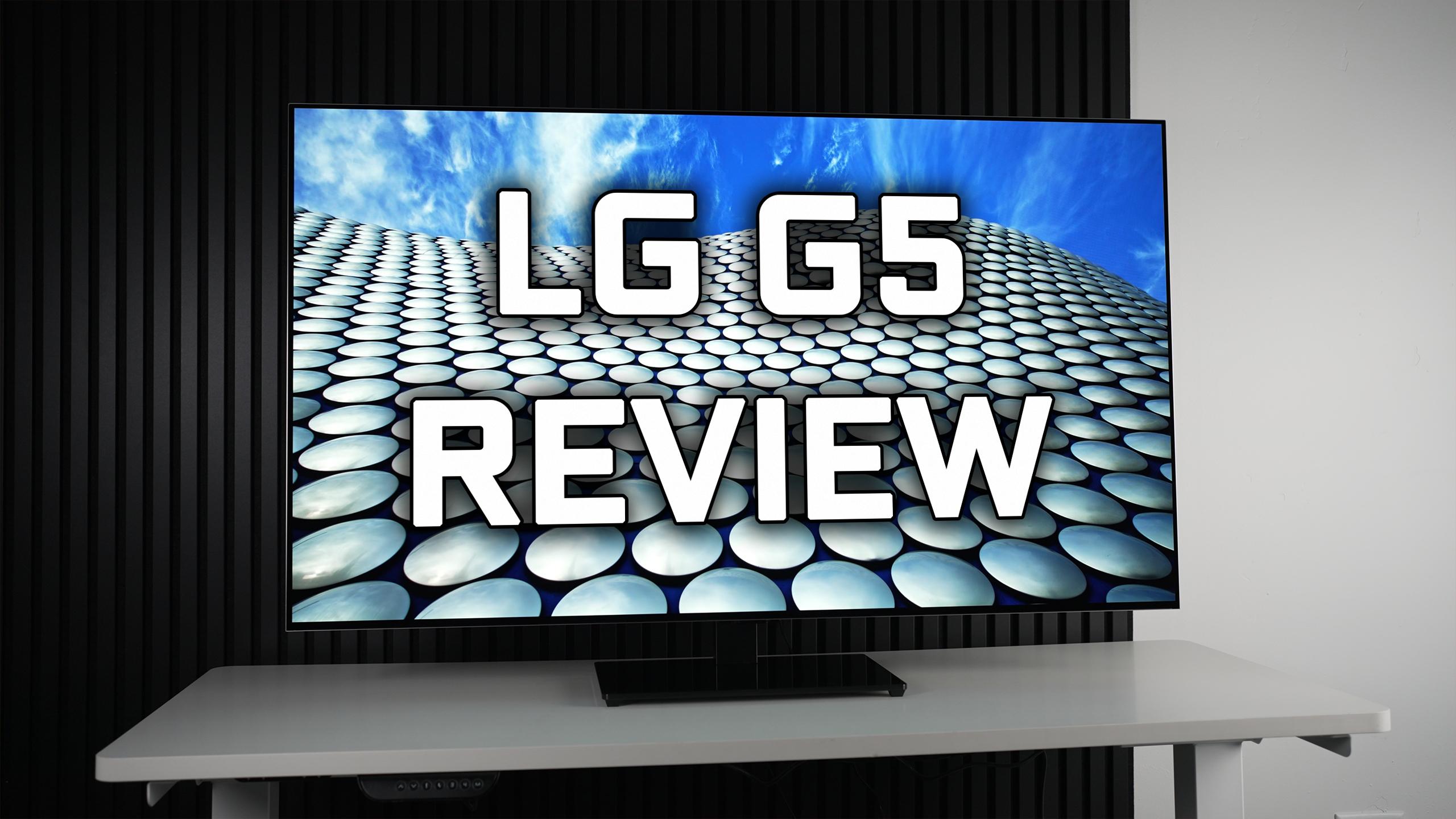
The LG G5 OLED is the TV I’ve been most excited to review this year—and for good reason. I tested the 55-inch model, which features LG’s new four-layer W-OLED panel, a 165Hz refresh rate, and the latest Alpha 11 Gen 2 AI processor. These upgrades bring major improvements to brightness, color, and gaming performance.
Yet for all its advancements over last year’s G4, the G5 isn’t perfect. So let’s dive in and see if it’s the right display for your setup.
The LG G5 OLED is easily the most impressive all-round OLED I’ve tested in 2025. It offers record-setting peak brightness, nearly QD-OLED levels of color coverage, and a 165Hz refresh rate that makes it a top-tier gaming display. Add in exceptional HDR impact, strong ambient light performance, and four full-bandwidth HDMI 2.1 ports, and it becomes clear this display is built for both gamers and home theater enthusiasts.
While it's not perfect—with minor issues like off-angle green tinting, sluggish menus, dithering, and white sub-pixel text clarity artifacts—the benefits far outweigh the drawbacks.
Disclaimer: This TV was purchased for review from Value Electronics, and all opinions are my own. Additionally Home Theater Review may run advertising campaigns with various manufacturers including LG. Finally I have joined Portrait Displays’ Calman color calibration software reviewer program to get free licensing going forward.
For this review I used an X-Rite i1 Pro spectrophotometer, Color Checker Display Plus colorimeter, Calman Ultimate, Portrait Displays Video Forge Pro 8K pattern generator, a Sony RX100 VII 1000fps camera, an SM208 Screen Luminance Meter, and a Sony Cinema Line FX3 mirrorless video camera. Plus years of display testing experience.

The 48” & 97” use a non 4-layer panel.

Above is the Connectivity for this TV. Most importantly it does come with four HDMI 2.1 ports capable of 4K 165Hz.
Unboxing the LG G5 OLED is a familiar but refined experience for anyone who's dealt with LG's high-end OLEDs in the past. The 55-inch model arrives in a slim, upright box with excellent internal padding and clear setup instructions printed directly on the packaging flaps—a thoughtful touch.
I was even able to set up the TV completely by myself (please don’t do it) without any trips to the ER, which is quite the accomplishment, though I will say the G5 is quite heavy for an OLED.
Right out of the box, the LG G5 OLED delivers impressively vibrant and well-balanced color—but as with most TVs, that performance depends heavily on the selected picture mode. LG continues to include a robust suite of calibration options, and this year’s G5 takes full advantage of the new four-layer W-OLED structure to produce richer saturation and improved tonal separation, especially in HDR.

LG G5 Color
But how accurate is it really, and does it require calibration to shine? Let’s take a closer look. Feel free to skip to the TL;DR if you’re not into the nerdy Portrait Displays’ Calman color calibration software stats.
Rec. 709 Testing

Out of the Box in Film Maker Mode, the LG G5 OLED follows the EOTF curve well, but has issues with white balance on my unit, and requires setting the color to auto.

Thankfully this is easily fixed, though behavior when hooked up to a PC is oddly different, requiring setting shadow detail in game optimizer to +6 on current firmware using an RTX 5090 to avoid crushed detail.
SDR Color Accuracy Test

Color Accuracy in Film Maker Mode for SDR content is solid. It can be improved further via Calman.
HDR Testing

The default HDR FMM mode in HDR is also great with only minor issues, though behavior when hooked up to a PC is oddly different, requiring setting shadow detail in game optimizer to +3 on current firmware using an RTX 5090 to avoid crushed detail.

Even at all common window sizes the G5 measures with only small overbrightening issues in FMM, though in real content it did not look overbrightened at all..
HDR Color Gamut

The LG G5 raises BT.2020 color coverage by nearly 10% (80.94%) vs last year’s G4 which sat at just ~72% BT.2020 UV! This is an unheard of improvement for WOLED and puts it just behind QD OLED which can range from 82%-89% in my testing depending on the panel.
HDR Color Accuracy

HDR Color Match results were above expectations.
The short version: Out of the box, SDR performance was impressive. Minor white balance and brightness deviations were easily corrected through menu adjustments. Post-adjustments, I recorded an average DeltaE of just 1.5—well within reference range.
For Movie watching and gaming on consoles it has great accuracy and massively improves color reproduction vs last year's G4. I was shocked to find that in some instances the G5 can now nearly match QD OLED panels and is not far behind Samsung’s best offerings.
Unfortunately many have reported and I did see myself some dithering (or crawling) near black or on some greys when I had it hooked up to a PC where I could sit closely to observe. It's unlikely to be very noticeable when viewing from a distance, but LG needs to fix this or allow users to disable it. Additionally when hooked up to a PC though it tends to want to crush shadow detail requiring separate adjustment, but overall it still looks great!
When it comes to raw brightness, the LG G5 OLED doesn’t just inch past its predecessor—it leaps. LG’s new four-layer W-OLED structure pushes the G5 into territory previously reserved for only the brightest Mini LED displays. Whether you're watching HDR movies or gaming in a sunlit room, this TV brings enough luminance to cut through ambient light and make specular highlights pop with intensity.

The LG G5 is the brightest OLED I’ve ever tested.
The G5 also manages to sustain incredible brightness in high APL scenes. Full-field brightness hovers around 400 nits in calibrated modes, and around 2500nits in a 10% window. This leads to exceptionally bright HDR imagery in real content.
LG’s dynamic tone mapping has also improved. In HDR10 content, the G5 intelligently maps metadata beyond 1,000 nits without excessive dimming. You can still toggle tone mapping off or use "HGIG" mode for more accurate rendering when paired with consoles like the PS5 or Xbox Series X, and the combination of Filmmaker Mode with Game Optimizer and professional tone mapping leads to incredibly bright HDR gaming.

The LG G5 is the brightest HDR display in real content I've ever measured.
More important than lab numbers, the real-world HDR experience is jaw-dropping. In scenes from Baldur’s Gate 3, the G5 hit over 2,200 nits in highlights and sustained over 700 nits in the terrain. That kind of performance gives HDR content a pop and dimensionality that’s rarely seen on OLEDs. Mini-LEDs used to hold the crown for highlight intensity, but the G5 legitimately dethrones all of them in visual impact at times.
This display is built for HDR. Whether you're watching Dolby Vision blockbusters or engaging RTX HDR in PC games, the dynamic range and specular detail are second to none.
As with all OLEDs, the LG G5 delivers perfect black levels due to its self-emissive pixel structure, far surpassing the capability of local mini led. But what really makes the G5 special is how well it preserves contrast across a variety of lighting conditions.

The LG G5 has exceptionally good ambient light handling with just 0.03nits reflected with overhead lights on.
When it comes to ambient light handling, the LG G5 massively outperforms QD-OLED displays, especially in bright room conditions. QD-OLEDs often struggle with perceived contrast in well-lit environments, as their black levels tend to lift and shadow detail becomes harder to see. In contrast, the G5 maintains deep blacks and vibrant highlights even with overhead lighting or daylight in the room. Its combination of extreme peak brightness, well-managed ABL, and refined screen coating allows the image to retain depth and dimensionality where QD-OLEDs begin to look flat. While the G5’s glossy panel does reflect some light, the overall viewing experience remains strikingly rich and immersive, even outside of a dark-room setup.
Where the G5 really shines is in mixed scenes: think bright windows against shadowy interiors. Here, the deep blacks and bright highlights work together to create a sense of depth that Mini-LEDs struggle to match, especially without blooming. Even compared to QD-OLEDs, the G5 often looks punchier in daylight conditions.

LG G5 contrast.
The glossy finish and high peak brightness boost perceived contrast dramatically, particularly when compared to QD-OLEDs like the S95F. For users in less-than-ideal lighting environments, the G5 maintains strong dynamic range without sacrificing black level integrity or elevating shadows. It's a stunning contrast performer—on par with or superior to anything else I’ve tested.
The LG G5 continues LG’s welcome trend of using a glossy screen finish, and it pays off massively in clarity and contrast. Fine details remain razor-sharp, and reflections are handled surprisingly well, making it one of the clearest TVs I’ve tested for mixed lighting environments.

Excellent LG G5 ambient light & reflection handling.
Compared side-by-side with Samsung’s S95F—one of the few other OLEDs with a 165Hz refresh rate—the G5 appears noticeably sharper and more vivid, especially in brighter rooms. The matte finish on Samsung’s QD-OLEDs can mute contrast and dull colors under ambient light, while the G5’s gloss preserves richness and pop.

LG G5 WRGB subpixel layout.
The G5 uses LG’s WRGB OLED subpixel structure, which can still cause minor fringing or shadowed edges around fine text, especially when viewed up close or on high-resolution desktop interfaces. This is a limitation inherent to WRGB layouts compared to RGB panels. However, outside of sharp UI elements or productivity use, the G5 delivers excellent overall clarity, with crisp image detail, clean motion, and no distracting grain or haze. For typical viewing distances and cinematic content, these subpixel quirks are virtually unnoticeable.
Gamers, this is the one. The LG G5 OLED is hands-down the best gaming display I’ve tested in 2025. Input latency measured at an incredibly low 26ms using a 1000fps camera—competitive with 240Hz OLED monitors. While there may be 1–2ms variance in manual tests, the takeaway is clear: it’s lightning fast.

165Hz Gaming latency.
The 165Hz refresh rate ensures fluid motion for high-frame-rate gaming, especially on PC. Pair this with four HDMI 2.1 ports and full VRR support, and you’ve got a display that’s tailor-made for next-gen consoles and enthusiast PC rigs.

LG G5 gaming.
The 165Hz refresh rate ensures fluid motion for high-frame-rate gaming, especially on PC. Pair this with four HDMI 2.1 ports and full VRR support, and you’ve got a display that’s tailor-made for next-gen consoles and enthusiast PC rigs.
What pushes it over the edge is its HDR gaming performance. Even with RTX HDR currently capped below 2,000 nits, the G5’s ability to exceed that means it’s future-ready. Games like Cyberpunk 2077 and Baldur’s Gate 3 looked absolutely stunning with rich highlights and dynamic contrast.

Motion Performance is exceptionally good.
To make things even better the LG G5 has exceptionally good motion performance thanks to its high refresh rate and near instantaneous response times afforded by OLED technology. To say it outclasses Mini LED for gaming is an understatement.

No judder reduction (left) vs max judder reduction (right).
LG’s motion interpolation tools are usable but not standout—best kept at the lowest setting to avoid visual artifacts. VRR flicker can also occur at erratic frame rates, as with most OLEDs, but it’s minor and infrequent.
OLEDs have long been praised for their excellent viewing angles, and the G5 continues that tradition—though not without small caveats. From head-on and moderate angles, color and brightness remain incredibly consistent, preserving the cinematic quality of HDR content.

LG G5 viewed at angle.
However, at more extreme angles, you’ll begin to notice a slight green tint—particularly on bright white backgrounds. This issue is not unique to the G5, but it remains an annoyance all the same.
That said, uniformity across the panel is excellent. I saw no evidence of banding, color blobs, or off-center brightness zones—issues that can still affect some OLED units even today. For most viewing scenarios, especially casual living room use, the G5’s viewing angles will be more than sufficient.
Audio quality on the 55-inch G5 is surprisingly good. Unlike the smaller 42-inch variant, which underwhelmed, this model delivers decent bass and clear mid-tones. It’s not on par with a dedicated sound system, but for casual use or gaming without a soundbar, it more than holds its own.
If there’s one area that needs attention, it’s LG’s firmware. The menu system is still sluggish, even in 2025, and navigating between settings can be frustrating. However, the feature set is robust: CalMAN AutoCal support, a suite of AI tools, numerous presets, and dedicated gaming features all add to the G5’s flexibility.
Game Optimizer mode could still use some tuning—Filmmaker Mode actually performs slightly better with Pro Tone Mapping adjustments.
The LG G5 OLED isn’t perfect, but it’s the closest thing I’ve seen so far. With record-setting brightness, vivid HDR, and elite gaming specs, it earns its place at the top. For most people—especially gamers and mixed-use households—this is the best display you can buy in 2025.

2025 LG G5 OLED.
It outshines QD-OLEDs in ambient conditions, matches or exceeds Mini-LEDs for impact at times, and delivers motion performance and input latency that’s class leading. While I still hope LG ditches the white sub-pixel in future for better viewing angles, text clarity, and color purity, fixes dithering on grey and near black, and polishes up the firmware experience, these are small complaints compared to the excellent HDR imagary its capable of putting out.
Simply put, the G5 represents what OLED has been building toward for years. After testing dozens of display s this year I can confidantly say the LG G5 is the overall best I'vs seen, especially for PC gamers. If you’re a serious enthusiast or hardcore gamer looking for an almost no-compromise display, this is it.
If you want to know how it stacks up against QD OLED, read my S95F review here!




Privacy Policy
Terms and Conditions - Affiliate Policy
Home Security
© Copyright 2008-2026.
11816 Inwood Rd #1211, Dallas, TX 75244