

We'd like to thank ProjectorScreen.com for their assistance with our projector evaluations and testing. Their yearly shoot-out, extensive selection and helpful attitude makes our life easier when we need to dig in a little more.
If you're shocked by the recent wave of projector brightness lawsuits, you haven't been paying attention.
What I am calling Lumen-Gate isn't some sudden moral collapse. It's the latest chapter in a very old story—one we've already lived through with garbage amplifiers, budget speakers, headphones, and countless other products that promised the moon and delivered a flashlight (flashlights too!).
The only difference this time? The numbers got so ridiculous that someone finally pushed back.
Let's be clear: this isn't about one company, one lawsuit, or one product line. This is about an entire segment of the market that quietly decided headline specs matter more than reality.

Over the past few years, multiple projector brands have been dragged into court and forced to correct wildly inflated brightness claims. Not opinions. Not reviewer disagreements. Actual court rulings and settlements. Models marketed at thousands—sometimes tens of thousands—of lumens were later corrected to fractions of those numbers once someone bothered measuring them using real standards.
Brands that lost or settled had to revise their specs downward, sometimes dramatically, and commit to using proper measurement standards going forward. That list includes multiple manufacturers operating primarily in the ultra-budget and online-marketplace space.
This isn't slander. It's documented fact. I am not afraid to name the brands that flat out lied and here they are.
I agree with Epson here, and I'll say it plainly.
False lumen numbers don't just hurt consumers. They hurt the entire industry.
They undermine trust in published specs. They punish honest manufacturers who play by the rules. They distort online marketplaces where inflated numbers win clicks. And they make legitimate products look overpriced or underpowered by comparison.
When brightness claims are fabricated or measured using made-up metrics, the comparison itself becomes meaningless. Once that happens, the entire spec sheet becomes suspect.
At the same time, let's not pretend this problem appeared out of nowhere. Epson didn't invent standards like ISO 21118—they already existed. What changed is that the exaggeration became impossible to ignore.
If you wanted to design a product where misleading specs could thrive, you'd land exactly where we are now.
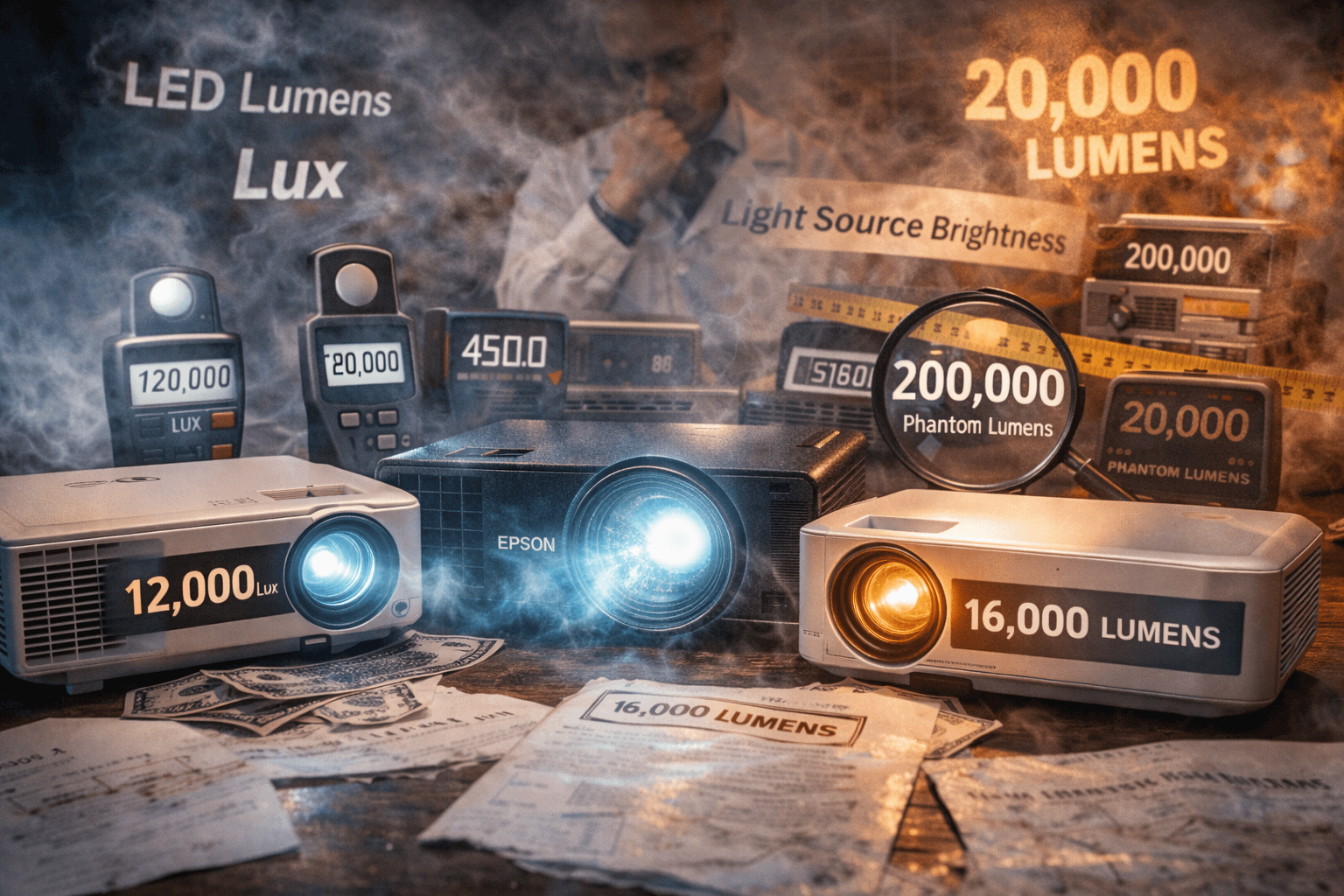
Lumens are abstract to most buyers, impossible to verify at home, dependent on test methodology, and easy to inflate without immediate consequences.
Be honest—how many consumers have the equipment, environment, and expertise to measure projector brightness accurately? I don't. Most reviewers don't. Almost no buyers do.
That makes lumens the perfect fantasy number.
Throw in vague marketing terms like "LED lumens," "lux," or "light source brightness," and you've got a system where numbers look scientific, sound impressive, and mean absolutely nothing in real-world comparison.
Sound familiar? It should.
This is the same playbook the AV industry has run for decades.
Amplifiers rated at "1,000 watts" that couldn't deliver a fraction of that power under real conditions. Speakers using peak or momentary ratings instead of continuous output. Headphones claiming frequency ranges that extend far beyond audibility with no usable output. Home-theater-in-a-box systems inflating wattage to win shelf space.
Every time, the defense is the same: the number wasn't technically wrong, just measured differently.
And every time, consumers are left trying to decode marketing instead of evaluating products.
Online marketplaces didn't create this problem—but they absolutely amplified it.
When sorting, filtering, and comparison tools reward the biggest number at the lowest price, honesty becomes a liability. A projector listed at "12,000 lumens" for $199 will always out-click a properly rated 700-lumen model from a reputable brand, even if the latter destroys it in real-world performance.
The platform doesn't verify specs. The consumer can't test them. The incentive to exaggerate is obvious and it pays.
That's not a loophole. It's the business model.
Here's my blunt advice: if you don't know the brand, ignore the specs.
Especially the specs you can't realistically verify—brightness, contrast ratios, power output, or any metric that requires lab equipment to confirm.
That doesn't mean every unknown brand is lying. It means the risk is yours, not theirs.
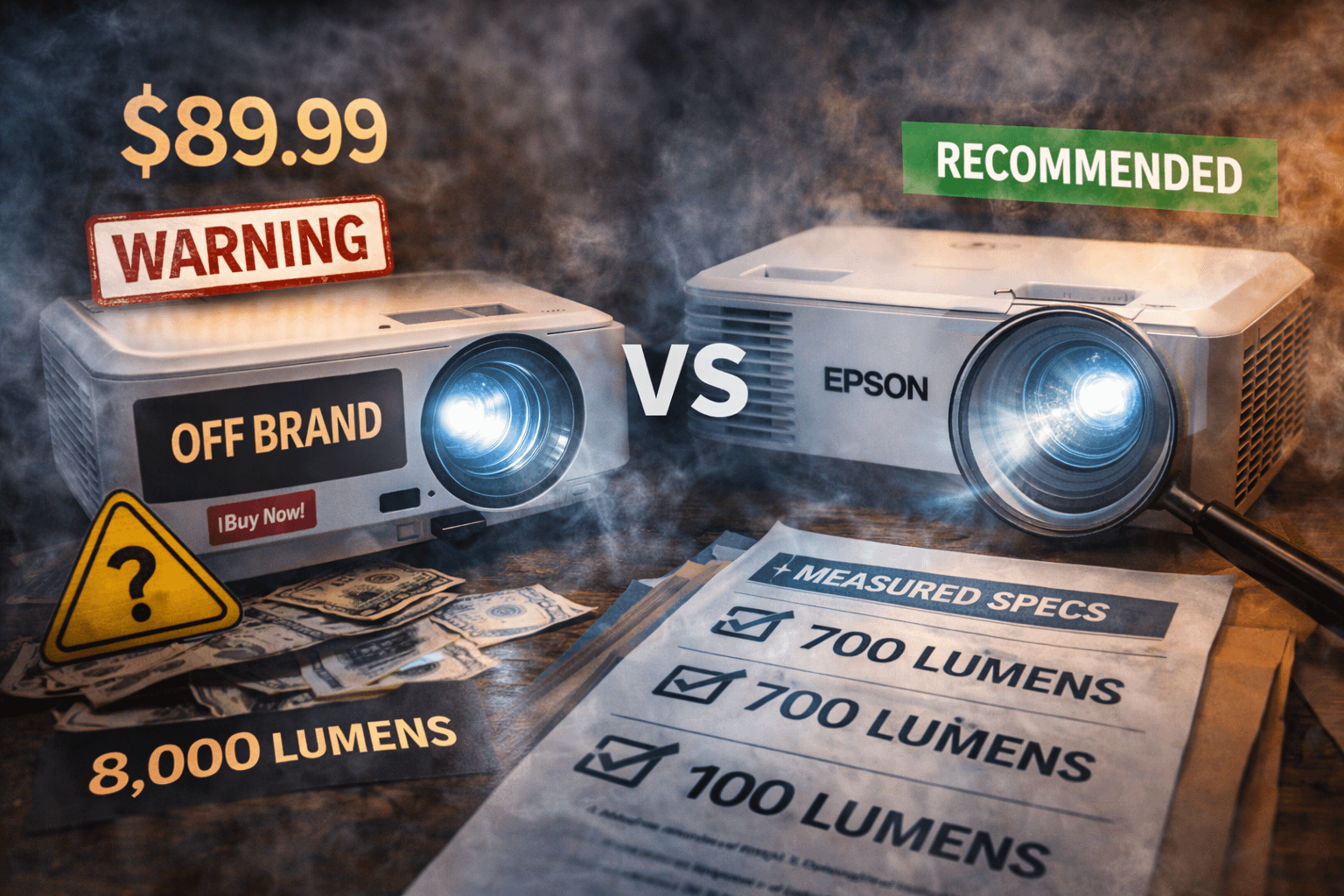
Buying a recognized brand doesn't guarantee perfection, but it dramatically increases the odds that published specs mean something, measurement standards were followed, and corrections won't require a lawsuit.
And if you decide to save money by going off-brand—and sometimes that makes sense—just understand what you're trading away. Treat the numbers as marketing, not engineering.
Here's the uncomfortable truth: the industry tolerated this behavior for years because it was inconvenient to confront it.
Standards existed. Experts knew, I mean I can tell with ease, I install and calibrate projectors for a living. I always just laughed it off when a client tells me they got a 6000 lumen projector on Amazon for $199. Reviewers whispered. Consumers adapted.
Nothing changed until the exaggeration crossed from optimistic to absurd.
That's why Lumen-Gate feels explosive. Not because it's new—but because it finally became undeniable.
This wave of corrections won't end exaggeration forever. It never does.
What it will do is force a temporary reset. New language will appear. New metrics will be invented. The same game will resume under a different name.
The lesson isn't to memorize standards. The lesson is skepticism. Because in AV—as in every tech category—when a number looks too good to be true, it usually is. And this industry has already taught us that lesson more times than it should have needed to.
Related Reading:
For advertising please contact the editor at [email protected]




Privacy Policy
Terms and Conditions - Affiliate Policy
Home Security
© Copyright 2008-2026.
11816 Inwood Rd #1211, Dallas, TX 75244