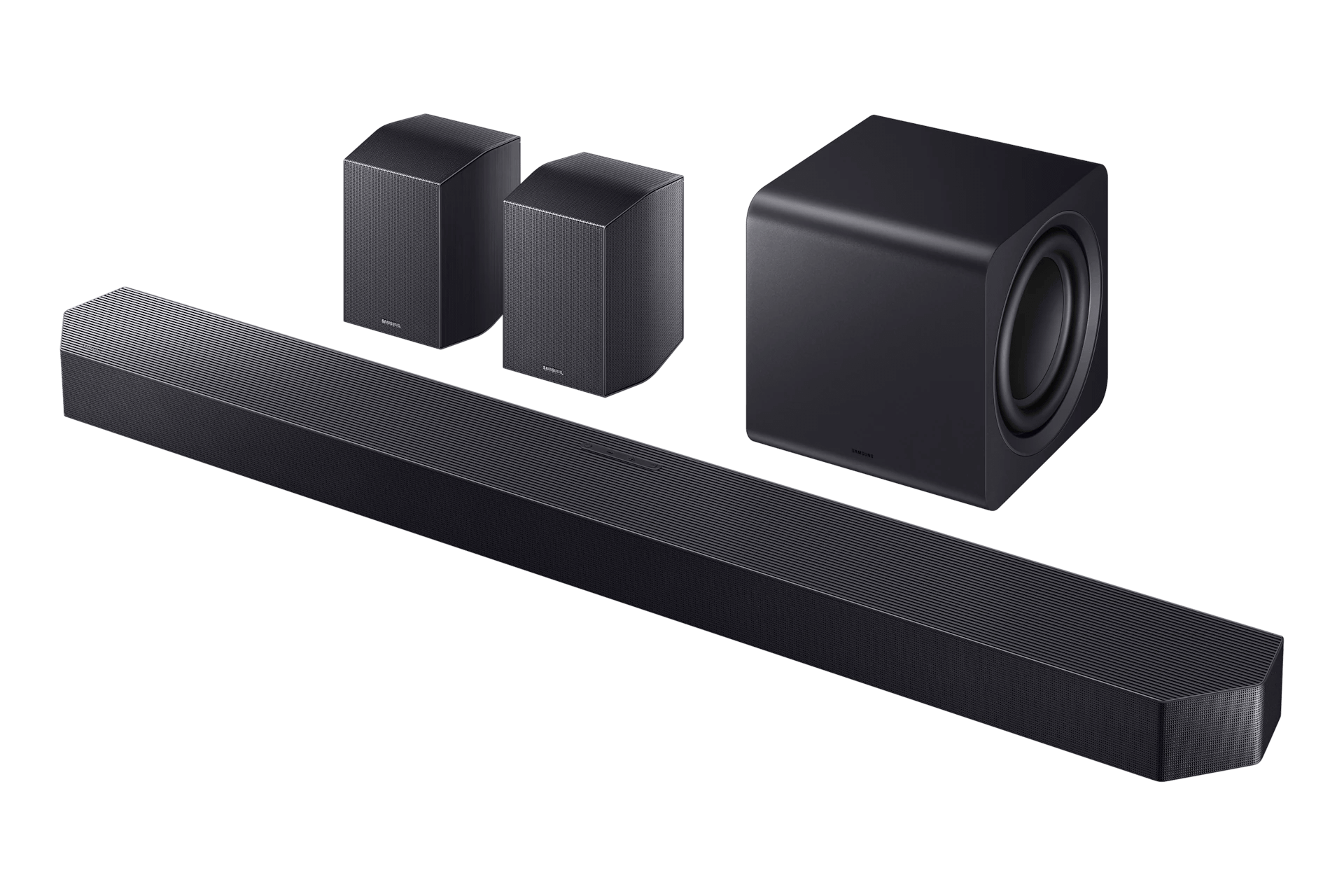
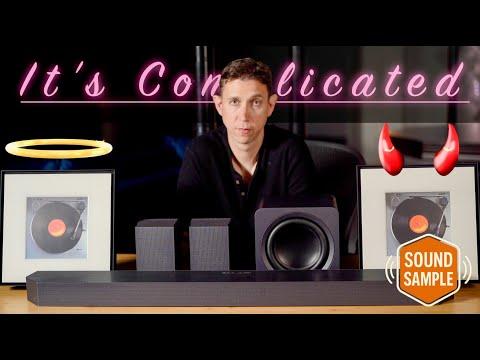
I've spent countless hours testing Samsung's flagship audio ecosystem, and I'll be honest—it's complicated. The combination of their Q990F soundbar, Music Frame speakers, and Frame TV represents Samsung's most ambitious attempt yet to create a truly immersive home theater experience. But after weeks of testing different configurations, dealing with software bugs, and fine-tuning settings, I've discovered both the remarkable potential and frustrating limitations of this $2,000 system.
Samsung's Q-Symphony technology has evolved significantly since its buggy early days. The concept is simple: sync your Samsung TV, soundbar, and wireless speakers to create a unified audio experience that goes beyond traditional surround sound. What's not simple is making it all work seamlessly together.
The system I tested includes the 2025 Q990F soundbar (Samsung's flagship four-piece system), two 2024 Music Frame speakers, and a 2025 Frame TV. Here's what surprised me: you don't actually need the latest soundbar to use two Music Frames. The magic happens in the TV—any 2025 or newer Samsung TV with Q-Symphony can handle dual frames, even with older soundbars like the 2023 Q990C.
This discovery opens up interesting possibilities for Samsung ecosystem users who want to expand their audio setup without completely starting over.
Getting everything connected requires the SmartThings app, and while Samsung provides a guided process, it's not exactly plug-and-play. You'll add each component individually—TV, soundbar, and both Music Frames—then configure them through the TV's Q-Symphony setup menu.
The positioning options are more flexible than I expected. You can place the Music Frames as front left/right speakers, rear surrounds, or in various combinations. I tested both configurations extensively: frames up front with the Q990F's dedicated surrounds in back, and the reverse arrangement.
Here's where things get frustrating: volume control becomes a complicated hierarchy. Adjusting a Music Frame's volume affects the entire system, though you do get limited independent control through Q-Symphony settings. More problematically, you cannot independently control or mute the TV's built-in speakers, which can seriously impact overall sound quality.
Let me set expectations correctly: this isn't going to turn your living room into a $10,000 theater overnight. The Music Frames don't deliver traditional left-right stereo separation. Instead, they handle ambient sounds, atmospheric effects, and background audio elements.
During my testing with films like "Oppenheimer," the frames excelled at creating spatial awareness. You hear air movement, subtle off-screen details, and environmental sounds that make scenes feel less confined. The frames essentially "undampen" the soundbar's more centralized presentation, adding width and atmosphere rather than discrete channel separation.
With music, results varied significantly. Modern mixes generally sounded more natural, but older recordings sometimes suffered from the frames overemphasizing peripheral sounds at the expense of vocals. The Music Frames act more like audio magnifying glasses, bringing out details that can either enhance or overwhelm the primary content.
Here's a crucial point that Samsung doesn't emphasize enough: your TV's audio quality significantly impacts the entire system. Since you cannot mute or independently adjust the TV speakers, a lower-end Samsung TV can drag down the whole experience with distortion and poor frequency response.
During frequency sweeps, I documented severe distortion from the 43-inch Frame TV at moderate volumes—distortion that colored the entire system's output. The Q990F alone produced clean, controlled sound, but the TV's contribution muddied the waters considerably.
My advice: if you're investing $2,000 in this audio system, don't skimp on the TV. Aim for Samsung's Pro series or larger models (75+ inches) that can handle the audio demands without distortion.
The good news: Samsung has dramatically improved wireless stability compared to previous generations. Where last year's systems suffered multiple dropouts per minute, I experienced far fewer connectivity issues even with more components active.
The bad news: software bugs persist throughout the experience. Settings options disappear randomly, audio sync controls show up sporadically, and the system occasionally kicks you out of Q-Symphony mode after power cycling. I frequently encountered situations where only one Music Frame appeared adjustable, or where functionality simply vanished until I unplugged everything and started fresh.
These aren't deal-breakers, but they highlight that Q-Symphony still feels more like advanced beta software than a consumer-ready solution.
Samsung's approach differs fundamentally from Sony's Theater Quad system. Where Sony focuses on creating discrete surround channels with proper separation, Samsung emphasizes atmospheric enhancement and ecosystem integration.
The Sony system offers more traditional surround sound benefits with better left-right separation, while Samsung provides unique atmospheric effects that work particularly well with movie content. Price-wise, both systems land in similar territory, but Samsung requires TV compatibility while Sony works universally.
For Samsung TV owners already invested in the ecosystem, Q-Symphony offers integration benefits you won't find elsewhere. For others, Sony's approach might prove more straightforward and reliable.
After extensive testing, I found the Music Frames work best positioned as front speakers with the Q990F's dedicated surrounds handling rear duties. This arrangement maximizes the atmospheric benefits while maintaining proper surround channel functionality.
The reverse configuration—Q990F surrounds up front, Music Frames in back—sacrifices too much spatial sophistication and reduces the effectiveness of height channels. The Music Frames simply don't replace proper surround speakers effectively enough to justify this arrangement.
This setup works best for Samsung ecosystem enthusiasts who enjoy tweaking and optimizing their audio experience. If you want to "set it and forget it," look elsewhere. The system requires ongoing attention based on content type, source quality, and personal preferences.
Ideal candidates include:
Consider alternatives if:
Samsung's Q-Symphony system with Music Frames represents an ambitious but flawed approach to home theater audio. The atmospheric enhancement and ecosystem integration offer genuinely unique benefits, particularly for movie content. However, software instability, TV dependency, and the need for constant adjustment limit its appeal to mainstream users.
The $2,000 investment makes sense for Samsung devotees seeking the most immersive Q-Symphony experience possible, especially when sales bring component prices down. For everyone else, Sony's Theater Quad offers a more straightforward path to wireless surround sound, while traditional soundbar systems provide better reliability and universal compatibility.
Samsung has made meaningful improvements in wireless stability, suggesting they're committed to refining this technology. With better software implementation, independent TV volume control, and system-wide auto-tuning, Q-Symphony could eventually deliver on its ambitious promises. For now, it remains an intriguing but high-maintenance option that rewards patience with occasional moments of audio magic.





Privacy Policy
Terms and Conditions - Affiliate Policy
Home Security
© Copyright 2008-2026.
11816 Inwood Rd #1211, Dallas, TX 75244