

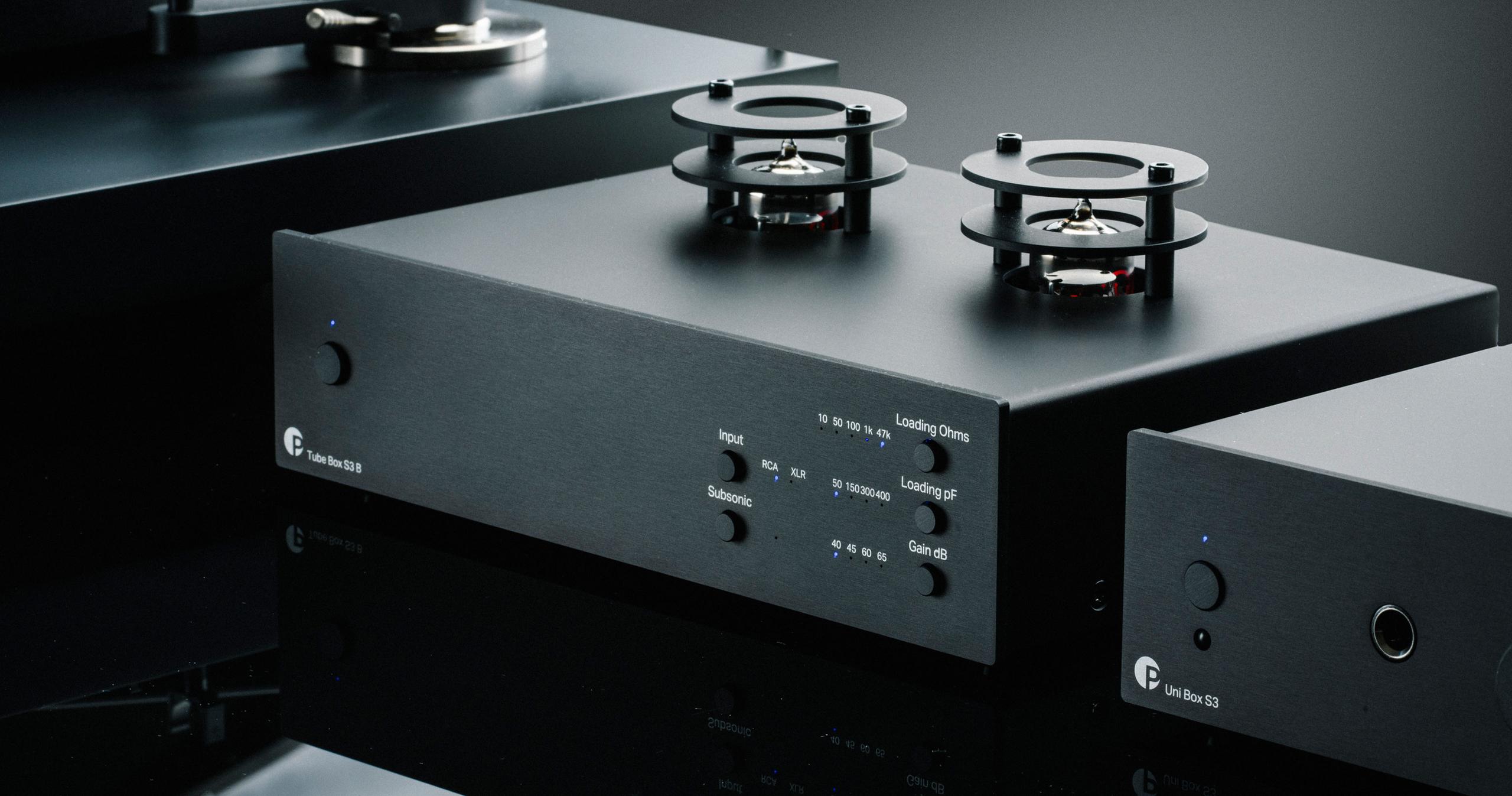
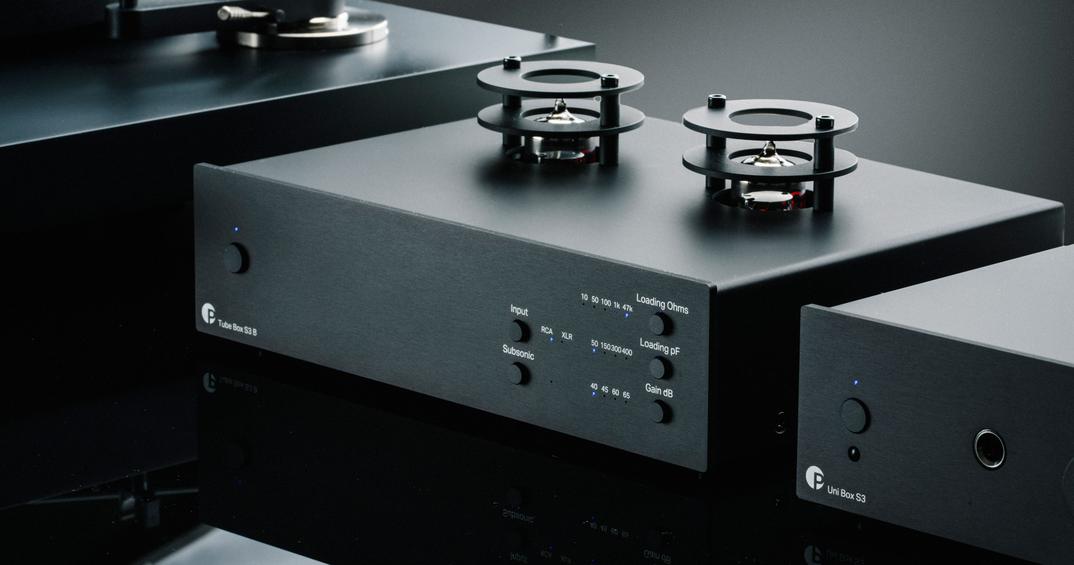
If you’ve been spinning vinyl for a while, you’ve probably come across the term phono preamp. Some turntables have one built in, which makes setup easier, but built-in stages are often the weakest link in the chain. They can add noise, flatten dynamics, or simply leave you wondering why your records don’t sound as good as you expected. That’s where an external phono preamp comes in, and Pro-Ject’s latest models — the Tube Box S3 B and Tube Box E — are designed to give listeners more options for clean, flexible, and characterful playback.
At their core, phono preamps do two jobs: they boost the very low-level signal coming from your cartridge, and they apply the equalization curve that makes records sound right. Without one, your music would be quiet, thin, and pretty unlistenable.

Pro-Ject already makes a wide range of preamps, but these new models are different because they’re tube-based. That means they don’t just focus on technical improvements over built-in stages — they also shape the sound in a way many listeners describe as smoother or more “analog.”
Let’s start with the bigger of the two. The Tube Box S3 B is built for people who want flexibility and room to grow. Its biggest selling point is balanced connectivity. If you’re using a turntable with a balanced output, this design helps cut down on noise and interference. It’s the same principle recording studios use to keep signals clean.

On the practical side, the S3 B gives you a range of gain settings from 40 to 65 dB, so it works with both moving magnet (MM) and moving coil (MC) cartridges. If you want to tweak your setup further, the front panel lets you adjust capacitance and impedance, or flip on a subsonic filter to reduce low-frequency rumble from records that aren’t perfectly flat.
One handy feature: the S3 B has two sets of inputs — one balanced, one unbalanced — so you can hook up two turntables at once and switch between them. That’s not something you see in most phono stages at this price.

Inside the aluminum case are two ECC83 tubes, which are user-replaceable. That means when the tubes eventually wear out, you can swap them, or even experiment with different brands if you want to try subtle changes in sound.
If the S3 B sounds like overkill for your setup, the Tube Box E is the more approachable entry point. It’s physically smaller (about the size of a couple of stacked paperback books) but still uses a dual-mono discrete design — essentially, each channel has its own circuit path, which helps keep noise down and separation clear.

Like its bigger sibling, the Tube Box E works with MM and MC cartridges and offers gain settings from 40 to 63 dB. You also get the option to adjust capacitance and impedance, and there’s a front-mounted subsonic filter for easy control.
It also comes in a metal enclosure with an aluminum faceplate, plus gold-plated RCA connections to keep the signal path stable. And yes, it too runs on dual ECC83 tubes that you can replace when needed.
Both the S3 B and the E are designed with flexibility in mind. They let you fine-tune your setup, support a wide variety of cartridges, and give you a way to replace tubes as time goes on. Both also use solid metal housings to minimize interference, which is always welcome when you’re dealing with such low-level signals.

Here’s how the numbers shake out:
Both are offered in black or silver finishes and are already available through European dealers. Pricing and timing for the U.S. hasn’t been finalized yet.
In simple terms, the Tube Box E is for anyone who wants a straightforward upgrade from a built-in preamp without spending too much, while the Tube Box S3 B caters to those who want balanced connections, multiple inputs, and a wider range of adjustments.
For vinyl listeners, these two models represent different paths: keep it compact and budget-friendly, or step up to a feature-packed preamp that can grow with your system. Either way, they highlight how important an external phono stage can be when you want to get the most out of your records.




Privacy Policy
Terms and Conditions - Affiliate Policy
Home Security
© Copyright 2008-2026.
11816 Inwood Rd #1211, Dallas, TX 75244