


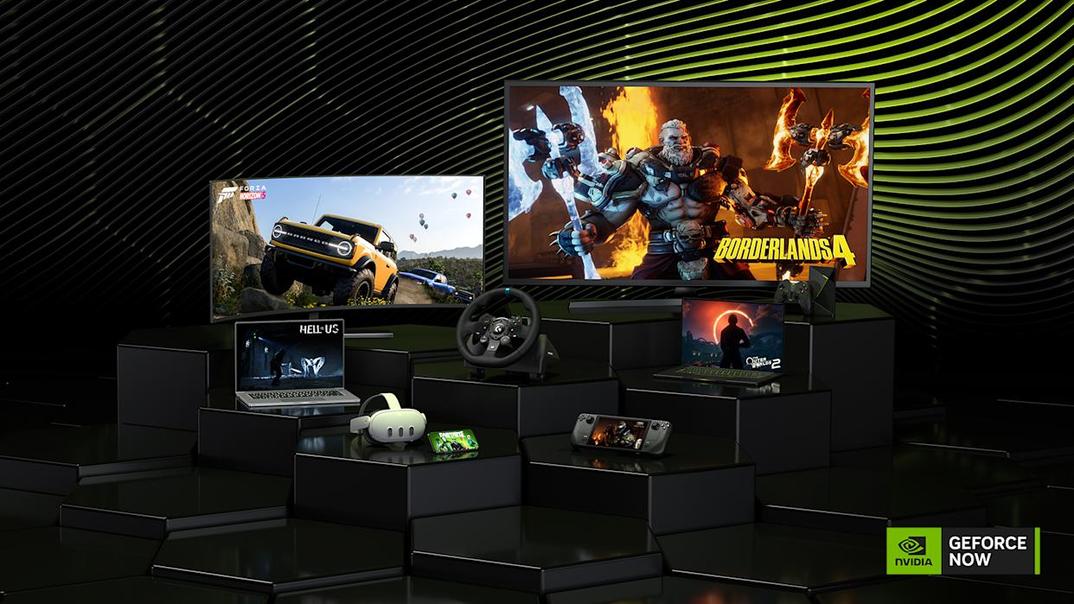
Nvidia is rolling out one of the biggest updates yet to its cloud gaming service, GeForce Now. Starting this September, the platform will run on the company’s new RTX 5080 GPUs, powered by its latest Blackwell architecture. Alongside the hardware boost, Nvidia is adding new features like Install-to-Play and Cinematic Quality Streaming, while also expanding the game library to thousands more titles.
For cloud gamers, this update could make GeForce Now feel a lot closer to playing on a high-end gaming PC — though some limitations still remain.
The most noticeable change is the arrival of RTX 5080 GPUs in GeForce Now’s Ultimate tier. These new cards bring serious horsepower: up to 62 teraflops of compute power and 48GB of memory, backed by new AMD “Zen 5” CPUs.

In real terms, that translates to performance that Nvidia says can be up to 2.8 times faster than the previous generation, with the ability to stream games at 5K resolution and 120 frames per second. At 1080p, frame rates can climb as high as 360 fps, while Nvidia’s Reflex technology helps keep input lag down. For many users, click-to-pixel response times could dip below 30 milliseconds — about what you’d expect from a good console setup at home.
It’s worth noting that not every Ultimate member will always land on a 5080-powered server right away. Some will still connect to RTX 4080-class systems, at least until the rollout is fully complete. Even so, having RTX 5080 power in the cloud is a major step forward.

Nvidia isn’t just boosting raw performance — it’s also trying to make streamed games look better. A new optional mode called Cinematic Quality Streaming (CQS) aims to cut down on the blur and color issues that sometimes show up when you’re streaming.
CQS combines several upgrades: AV1 encoding, HDR10 support, and YUV 4:4:4 chroma sampling, which keeps text sharp and colors more accurate. AI-powered filters help clean up motion-heavy scenes, while the maximum streaming bitrate is increasing from 75 Mbps to 100 Mbps.
For anyone playing on a high-res display — whether that’s a 5K OLED monitor or a big 4K TV — the improvements should be especially noticeable. Nvidia showed off examples in Black Myth: Wukong, with foliage and textures looking much more detailed compared to older streams.

One of the most exciting additions is Install-to-Play, which effectively doubles GeForce Now’s library from around 2,300 titles to more than 4,500 games.
Up until now, Nvidia had to curate and preinstall each game that could be played on GeForce Now. With Install-to-Play, any Steam title that supports Valve’s Cloud Play system can be installed directly onto Nvidia’s cloud servers. That means a lot more of your PC collection could be playable instantly in the cloud.
There are some trade-offs, though. Unlike curated games, Install-to-Play titles need to be downloaded to Nvidia’s servers at the start of each session unless you pay for persistent cloud storage. By default, Performance and Ultimate members get 100GB of temporary storage, but you can upgrade to 200GB for $2.99/month, 500GB for $4.99/month, or 1TB for $7.99/month if you want to keep games installed between sessions.
The good news is that these downloads should be quick. Nvidia’s servers are connected directly to Valve’s, so install times are often much faster than you’d get at home.

Lag is often the biggest complaint about cloud gaming, and Nvidia is addressing that with Low Latency Streaming (LLS). This combines its Reflex tech with newer networking tools like L4S, while working with ISPs such as Comcast, Deutsche Telekom, and BT Group to help smooth out connections.
The result, according to Nvidia, is response times as low as 30 milliseconds, which could make cloud gaming fast enough even for competitive shooters or racing games.
Device support is also expanding. The Steam Deck OLED now streams at 90Hz (up from 60Hz), while LG OLED TVs and monitors support 4K at 120Hz and even 5K at 120Hz on supported hardware. Logitech racing wheels with haptics are also supported, and Mac users will get the same RTX 5080 upgrades through the GeForce Now app.

Another new feature is Nvidia’s partnership with Discord and Epic Games, which lets you launch some games directly from within Discord. Fortnite will be the first to support this “Instant Play” option, allowing you to join a match without downloads or logins. It’s designed to make jumping into a game feel quicker and more seamless — especially if you’re just trying something out with friends.
Nvidia also announced a lineup of new titles coming to the service, including Borderlands 4, Call of Duty: Black Ops 7, The Outer Worlds 2, and Dying Light: The Beast. Together with Install-to-Play, GeForce Now’s library is bigger than ever.
Still, it’s not all good news. Sony and Rockstar games will likely remain absent, meaning titles like Spider-Man, God of War, Horizon, Ghost of Tsushima or Grand Theft Auto and Read Dead Redemption 2 won’t be available anytime soon. For players (including myself) who were hoping this update would bring those publishers into the fold, that’s a noticeable gap.

Despite all the new features, Nvidia isn’t changing its pricing. The Ultimate tier stays at $19.99 per month, or $99.99 for six months. The Performance tier is still $9.99/month, and the free tier continues with limited one-hour sessions.
The upgrades — RTX 5080 servers, CQS, Install-to-Play, and Instant Play — will start rolling out in September 2025 and will expand to more regions over time.
With this update, Nvidia is bringing GeForce Now much closer to what many gamers expect from a traditional PC setup: faster performance, better visuals, and a much bigger game library. Features like Install-to-Play and Cinematic Quality Streaming help tackle two of the service’s biggest weaknesses — limited game choice and streaming quality.
But the likely absence of games from big publishers like Sony and Rockstar remains a sticking point, and some players may not love the idea of paying extra for persistent storage.
Overall, though, these updates show Nvidia is serious about making cloud gaming more practical for everyday use. Whether it’s on a Steam Deck, a MacBook, or a living room TV, GeForce Now is aiming to make high-end PC gaming feel less tied to expensive hardware — and more like a service you can access anywhere.





Privacy Policy
Terms and Conditions - Affiliate Policy
Home Security
© Copyright 2008-2026.
11816 Inwood Rd #1211, Dallas, TX 75244