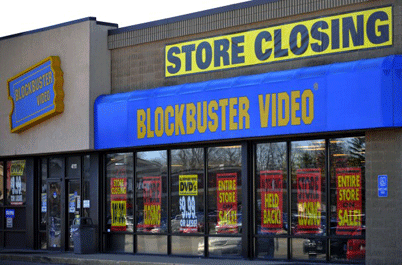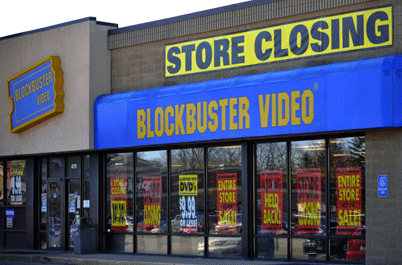
 You'll have to forgive me if I seem a bit out of sorts. I'm in mourning, you see. I've lost a friend that I've known since childhood. Her name was Blockbuster Video. She was born in Dallas in 1985, close to my childhood home of Plano, Texas. But we didn't really grow close until I was in my twenties, living in Los Angeles. She shared my passion for movies, and I carry fond memories of many a Friday or Saturday night spent hanging out together. She introduced me to some of my favorite films, some of which were smaller, lesser-known films that I discovered when forced to browse because the New Releases section had been wiped clean.
Admittedly, Blockbuster and I had grown apart over recent years. Her presence in my life dwindled. She no longer lived close by, and it grew more difficult for us to connect. I made some new friends, Netflix and Redbox, who also shared my passion. Redbox lives right around the corner (in fact, a family of three Redboxes resides at the corner strip mall). Netflix was always willing to come right to my house, and now she actually lives with me. I guess my loyalties are fickle, and convenience won out over nostalgia.
 Still, it was with sadness that I read the recent news that parent company Dish Network has decided to close down its few hundred remaining Blockbuster stores, as well as the DVD-by-mail program. According to the New York Times, about 50 stores around the country that are independently owned will remain open, at least for now. The announcement didn't come as a surprise to anyone. Blockbuster has been ailing for a number of years. Dish Network just purchased the company through bankruptcy auction in 2011, primarily to acquire its digital distribution catalog. The Blockbuster On Demand pay-per-use VOD service and the Blockbuster @ Home streaming service (exclusively available to Dish satellite customers) will live on.
It's kind of ironic that the Blockbuster brand will now exist primarily in VOD form, given that VOD is essentially what killed the video store. Blockbuster, which itself was responsible for the death of many a mom-and-pop video store, was ultimately done in by the convenience of streaming video-on-demand - first and foremost by Netflix, and then by a diverse crop of competitors, including the iTunes Store, Amazon Instant Video, Hulu, and CinemaNow. Why get in a car and drive to the video store, where you may or may not find the title you want, when you can simply press a few buttons on your TV, Blu-ray player, cable/satellite box, or streaming media player to watch the same movie?
Well, quality is one reason. The quality of streaming VOD is getting a lot better, but it's still not up to Blu-ray standards, particularly on the audio side of the equation. If I'm going to rent a low-budget indie film or just plan to casually take in a flick, I'm content to use a video-on-demand service but, when we're talking about a big-ticket (ahem) blockbuster release, I want pristine video and high-resolution audio, and I'm willing to drive to my local video store or kiosk to get it. Broadband limitations are another reason. Some people don't have the broadband speeds necessary for a good streaming experience, and some people just don't have broadband or the equipment to access streaming content. Now that Blockbuster is gone, the primary options for disc rentals are Netflix's by-mail program (Netflix has clearly shifted its focus to streaming, so it remains to be seen how long the company will keep its by-mail program alive) and Redbox, which has a very limited selection of titles within each kiosk.
Read more about Blockbuster and their demise on Page 2







Privacy Policy
Terms and Conditions - Affiliate Policy
Home Security
© Copyright 2008-2026.
11816 Inwood Rd #1211, Dallas, TX 75244