


Buying a normal pair of speakers is relatively forgiving. Put them in the room, move them around, change the toe-in, decide you don't like them, and you can always box them up again.
In-wall speakers raise the stakes considerably.
Once drywall starts coming out, changing your mind isn't nearly as convenient. You have to think about stud locations, mounting depth, wiring, speaker orientation, what is happening inside the wall cavity, and whether the speakers you're installing today will still make sense several years from now.
The upside is substantial. A well-designed in-wall system can deliver serious home theater or stereo performance while leaving the room almost completely free of speaker cabinets. In a dedicated theater, architectural speakers can also sit behind an acoustically transparent projection screen, putting dialogue and effects where they appear to come from on screen rather than above or below it.
For this 2026 guide, we looked at current pricing, specifications, installation flexibility, system compatibility, enclosure design, and what each speaker brings to a real-world installation. Our picks range from a $199 speaker that takes an unusually thoughtful approach to aiming the sound toward the listener to serious custom-install models costing well over $2,000 each.
Prices and availability can change, particularly with custom-install products.
Price: $1,299 each at Crutchfield

Focal's 300 IWLCR6 sits in a useful middle ground. It is expensive enough to be considered a serious architectural speaker, but it doesn't immediately send a three-channel front stage into five-figure territory. More importantly, it was designed as an actual LCR speaker rather than simply a conventional two-way model that happens to fit inside a wall.
The three-way design combines two 6.5-inch Flax-cone woofers with a 4-inch Flax midrange and Focal's inverted-dome tweeter. Focal rates the speaker from 40 Hz to 28 kHz within ±3 dB, with 92 dB sensitivity, an 8-ohm nominal impedance and recommended amplifier power of 50 to 150 watts. Mounting depth is only 3.69 inches.
What really helps the 300 IWLCR6, though, is flexibility. The midrange/tweeter section can rotate 90 degrees, allowing the speaker to be installed vertically for the left and right channels or horizontally as a center. Midrange and treble levels can also be adjusted to account for the room and placement.
That matters because the center speaker is often where architectural systems get awkward. A speaker designed primarily to stand vertically may behave differently when simply turned on its side. Focal has accounted for both orientations from the start.
At $1,299 each, three of them would cost $3,897 before adding surrounds, Atmos channels or subwoofers, so this certainly isn't a budget solution. But for someone building a higher-end living room or dedicated theater without moving into extreme custom-install pricing, the 300 IWLCR6 is one of the more balanced options on this list.
Price: $199 each at RSL Speakers

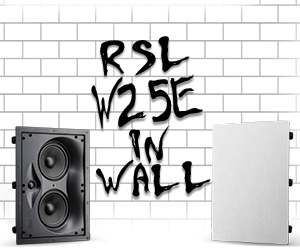
The RSL W25E proves that an interesting in-wall design doesn't necessarily have to cost four figures. It uses two 5.25-inch mineral-filled poly-cone woofers and a 22mm fabric-dome tweeter, with a rated frequency response of 48 Hz to 20 kHz ±3 dB, 91 dB sensitivity and recommended amplifier power of 35 to 175 watts. At $199 each, a five-speaker system would cost just $995 before adding a subwoofer.
Its most useful feature is something much simpler: the entire driver baffle is angled by 15 degrees. Typical in-wall speakers fire straight ahead. That's fine when the listening position happens to be directly in front of them, but unlike a bookshelf or tower speaker, you can't simply rotate an in-wall speaker inward to improve imaging.
RSL's angled baffle gives the installer some of that aiming ability back. The W25E can also be installed vertically or horizontally, with the orientation selected according to whether it is acting as a left, right or center speaker.
The mounting depth is 3.75 inches, and the wall opening is only 13 by 8.875 inches. RSL also provides clamps that accommodate unusually thick wall construction.
At $199, the W25E is one of the most affordable in-wall speakers to offer this kind of installation flexibility. Its angled baffle, compact cutout and adaptable orientation make it especially appealing for living rooms and smaller theaters where seating may not be directly centered on the speakers.
That combination of price and thoughtful design makes the W25E our budget pick and one of the easiest recommendations in this guide.
Price: $279 each at Amazon

RSL gets the lowest-price award, but the Polk Audio 265-RT is our value pick because it combines affordable pricing with a larger driver complement and straightforward installation.
For $279 each, the 265-RT uses two 6.5-inch Dynamic Balance mineral-composite polypropylene woofers and a 1-inch silk/polymer tweeter. Polk quotes a -3 dB response of 45 Hz to 25 kHz, 91 dB sensitivity and an 8-ohm nominal impedance. Mounting depth is only 3.56 inches.
Three 265-RTs across the front of a theater cost $837. That's less than one Focal 300 IWLCR6. That price difference leaves considerably more room in the budget for something an in-wall system still needs: subwoofers.
The Polk's low-frequency extension looks respectable on paper, but 45 Hz at the -3 dB point is not a substitute for a properly integrated subwoofer. In a home theater, I'd rather cross these speakers over to capable subs than ask a pair of 6.5-inch drivers mounted inside a wall to reproduce the deepest movie effects.
The 265-RT doesn't provide the sealed enclosure, sophisticated driver technologies or orientation flexibility of some of the more expensive speakers here. But that is also why it makes sense. It offers a lot of usable speaker for $279 without pretending to be a $2,000 architectural design.
Price: $694.99 each at Amazon

Speaker sensitivity doesn't receive enough attention when people build home theaters. The Klipsch PRO-250RPW LCR is rated at 94 dB sensitivity at 2.83 volts/1 meter, considerably higher than several speakers in this guide. It combines two 5.25-inch Cerametallic woofers with a 1-inch titanium-dome tweeter mounted to a Tractrix horn. Klipsch specifies a 46 Hz to 23 kHz ±3 dB response, 8-ohm compatibility, 75-watt RMS power handling and a 3.78-inch mounting depth.
Why should you care about that 94 dB number?
Higher sensitivity means a speaker can generally produce more output from the same amount of amplifier power. That's particularly useful in a larger theater where several channels may be playing loudly at the same time and the AV receiver has to divide its available power among them.
It doesn't mean the Klipsch is automatically better than a lower-sensitivity speaker. Sensitivity is only one part of speaker performance. But for a system designed around dynamic movie playback and higher listening levels, efficiency can be more useful than simply buying a receiver with a bigger wattage number printed on the box.
At $694.99 each, the PRO-250RPW also provides a logical step between the Polk/RSL options and the four-figure architectural speakers.
Price: $1,700 each at Dreamedia

The RBH Sound Reference 621-I takes a different approach from many conventional architectural speakers because it can be installed as a complete sealed loudspeaker system rather than relying entirely on the wall cavity behind it.
RBH uses two 6.5-inch aluminum-cone woofers with cast aluminum baskets and an AMT tweeter. The company rates the speaker at 60 Hz to 20 kHz ±3 dB, 90 dB sensitivity, 6 ohms and 75 to 200 watts of recommended amplifier power. It can serve as a main, center or surround speaker and can be mounted horizontally or vertically.
The complete system includes either an in-wall cabinet or retrofit bracket, while the dedicated HDF enclosure measures 14 by 28 inches and only 3.5 inches deep. The complete speaker weighs 27.5 pounds.
Dreamedia currently lists the Reference 621-I Complete Set at $1,700 per speaker, while RBH itself directs customers to dealers for pricing.
That enclosed design deserves more attention than it might initially get. With an open-back architectural speaker, the space behind the drywall effectively becomes part of the speaker system. Cavity volume, insulation and construction can therefore affect what happens acoustically.
A properly engineered sealed enclosure gives the manufacturer greater control over the air volume behind the drivers. It can also make results more repeatable from one channel to another and from one installation to another.
That's particularly attractive in a dedicated home theater, where predictability matters and where three identical 621-I speakers could be installed vertically behind an acoustically transparent screen. The 60 Hz lower limit also shouldn't be viewed as a major disadvantage. A system at this level should almost certainly be using one or more serious subwoofers anyway.
Price: $1,749 each at Monitor Audio

Many in-wall speakers are marketed primarily around home theater. Monitor Audio's Creator W3M is an interesting choice when music performance is equally important.
The W3M is a true three-way model using two 5-inch RDT III bass drivers, a dedicated 3-inch C-CAM midrange and Monitor Audio's MPD II high-frequency transducer.
Monitor Audio rates it at 45 Hz to 60 kHz installed at -6 dB, with 88 dB sensitivity, a nominal 6-ohm impedance and recommended amplifier power of 60 to 225 watts. It costs $1,749 each in the U.S. and requires only 3⅜ inches of mounting depth.
The dedicated midrange is part of what makes the W3M interesting. Instead of asking a woofer to handle both bass and much of the vocal range before handing things over to the tweeter, the three-way architecture divides that work among more specialized drivers.
Monitor Audio also provides corner compensation and adjustable midrange and high-frequency settings, which is useful because architectural speakers don't always get installed in acoustically ideal positions.
The Creator range also illustrates how far modern custom-install speakers have moved beyond the old idea of putting inexpensive utility speakers in the wall. The W3M costs as much as some very capable conventional bookshelf or floorstanding designs, so its appeal isn't simply that it disappears. It's intended for installations where keeping the room visually clean can't mean treating sound quality as an afterthought.
Price: around $1,800 each through dealers

The DALI PHANTOM M-250 addresses another common architectural problem: how do you build a proper speaker enclosure when there's barely any room inside the wall?
Its cabinet is only about 100 to 103mm deep, or roughly four inches, yet DALI still uses an engineered enclosure rather than treating the wall cavity itself as the cabinet. The M-250 contains two 5.25-inch wood-fiber woofers and a 28mm soft-dome tweeter.
Specifications include a 58 Hz to 24 kHz ±3 dB frequency range, 89 dB sensitivity, 6-ohm nominal impedance, 107 dB maximum SPL at one meter and recommended amplifier power of 30 to 180 watts. A U.S. dealer currently lists the speaker for $1,800 each.
DALI designed the M-250 for use as a front, center or surround channel, as well as for conventional two-channel listening. The slim cabinet makes it especially interesting for rooms where depth is limited but the owner still wants the predictability of an enclosed speaker.
It isn't the cheapest way to put sound in a wall. Three across the front would cost roughly $5,400. But the M-250 shows why architectural speaker prices can't always be compared by simply counting drivers. Cabinet engineering, installation depth and the ability to produce consistent results inside different walls can be just as important.
Price: $2,299.99 each at Crutchfield

KEF could have occupied this category with something far more expensive. Its architectural lineup extends to models costing many thousands of dollars per speaker.
The Ci3160RLM-THX is still expensive at $2,299.99 each, but it sits at a point where KEF's higher-end technology and serious home-theater design come together without entering the company's most extreme price tier.
The speaker combines KEF's 12th-generation Uni-Q driver array with Metamaterial Absorption Technology and two 6.5-inch hybrid-aluminum bass drivers. It carries THX Certified Ultra certification and is rated for 50 to 350 watts.
KEF specifies 89 dB sensitivity, 4-ohm nominal impedance, 110 dB maximum SPL at one meter and a broad nominal coverage angle of 150 degrees. Mounting depth is 3.9 inches.
That wide dispersion is particularly relevant in a theater with several seats. A home-theater speaker doesn't only need to sound right at one perfect spot in the middle of the couch; it needs to maintain sensible tonal balance and imaging across a wider listening area.
The 4-ohm impedance is worth noticing as well. This isn't the speaker I'd automatically pair with the least expensive AVR available. A three-channel KEF front stage deserves amplification that is comfortable with lower-impedance loads and the playback levels the system is expected to reach.
Three Ci3160RLM-THX speakers come to just under $6,900, so this is firmly premium territory. But compared with some cost-no-object architectural designs, it still occupies a surprisingly rational place in the high-end market.
Choosing the speaker is only half of an in-wall project. Installation can have as much influence on the final result as moving from one model to another.

Before ordering anything, check:
Professional installation isn't mandatory for every project, particularly in a straightforward retrofit where the owner is comfortable working with drywall and pulling cable. But complicated walls, fire blocks, insulation, electrical wiring and unusual framing can turn an apparently simple job into something considerably harder.
One of the biggest advantages of an in-wall theater is easy to overlook. Traditional living-room systems frequently use two vertical tower or bookshelf speakers with a horizontally arranged center beneath the TV. That center may contain similar drivers, but it isn't necessarily acoustically identical to the left and right speakers.

With an acoustically transparent projection screen, you can install three identical speakers at approximately the same height behind the image.
That means a voice or effect moving from left to center to right is being reproduced by the same speaker design in all three positions.
Several models in this guide — particularly the Focal, RBH, RSL and DALI — are explicitly designed with flexible LCR use in mind. For a dedicated theater, that may be a more important advantage than making the speakers invisible.
This is one of the biggest differences to understand before comparing prices. Many architectural speakers are effectively infinite-baffle designs. The drivers sit in the wall, and the cavity behind them becomes part of the acoustic environment.

That makes installation easier and keeps the speaker relatively inexpensive, but two rooms with different wall construction won't necessarily present exactly the same conditions behind the drivers.
Models such as the RBH Reference 621-I and DALI PHANTOM M-250 take more of that variable out of the equation by providing a designed enclosure.
That doesn't automatically make an enclosed speaker sound better. Open-back models can perform extremely well when properly installed.
The practical advantage is consistency. Enclosures can also help reduce sound traveling into the room on the opposite side of the wall, although anyone trying to seriously soundproof a theater will need to address the entire wall structure rather than relying on the speaker enclosure alone.
There isn't one in-wall speaker here that makes sense for every room.
The RSL W25E is the obvious place to start when price matters most. At $199, its angled baffle and flexible LCR orientation are unusual features for the money. It is an especially strong choice for buyers who want a budget-friendly speaker with more placement flexibility than a typical straight-firing in-wall model.
At $279, the Polk Audio 265-RT is the value choice for buyers who want an affordable, straightforward architectural speaker with a larger driver complement and simple installation requirements.
The Klipsch PRO-250RPW LCR makes sense when efficiency and theater output are priorities, while the Monitor Audio Creator W3M is the more interesting choice for a system expected to spend plenty of time playing music.
For higher-end custom theaters, the RBH Sound Reference 621-I stands out because its sealed HDF cabinet, dual 6.5-inch woofers, AMT tweeter and LCR flexibility make it particularly easy to imagine as part of a three-identical-speaker front stage. At Dreamedia's current $1,700 price, it lands between the Focal and KEF in this group.
The DALI PHANTOM M-250 is compelling where installation depth and enclosure consistency matter, while the KEF Ci3160RLM-THX is our premium choice for someone building a serious theater around wide dispersion, substantial output capability and THX Ultra certification.
For most buyers, though, the Focal 300 IWLCR6 strikes the best balance. It's flexible enough to work across the front stage, relatively shallow, sensitive enough to work with a broad range of amplification, and priced below the increasingly specialized designs at the top of the architectural market.
Whichever model you choose, spend as much time planning the wall as you do choosing the speaker. With normal speakers, bad placement can be corrected by moving a cabinet. With in-wall speakers, the drywall remembers your first decision.




Privacy Policy
Terms and Conditions - Affiliate Policy
Home Security
© Copyright 2008-2026.
11816 Inwood Rd #1211, Dallas, TX 75244