$999.00
The Triangle Esprit Titus EZ bookshelf speakers represent something special in today's crowded audio market. While countless manufacturers chase after the latest exotic materials and complex driver arrays, Triangle has taken a different approach with these compact French speakers. They've focused on perfecting fundamental acoustic principles, and the results speak volumes—quite literally.
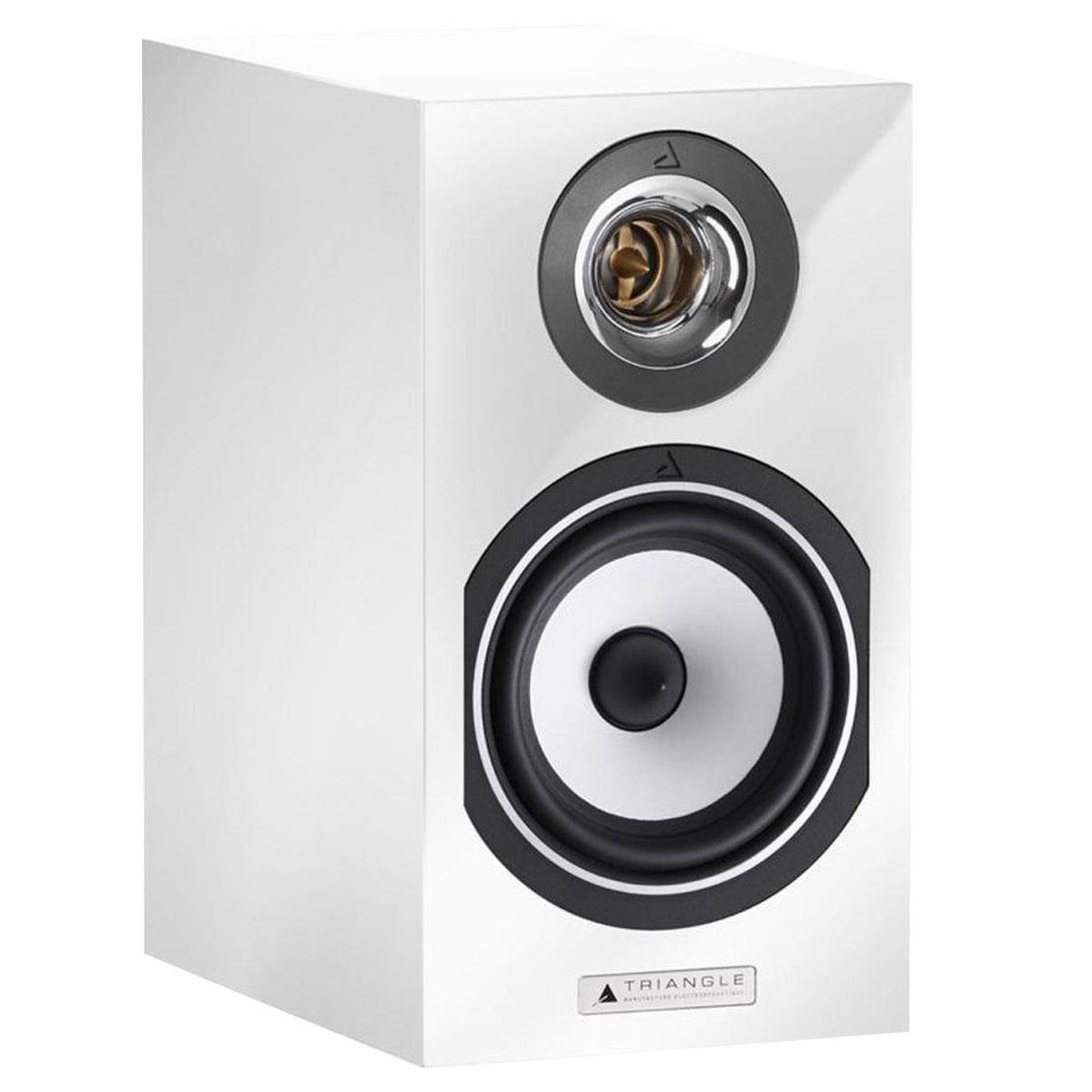
At first glance, the Titus EZ might seem unremarkable. They're compact bookshelf speakers with a two-way design (meaning they use just two drivers: a tweeter for highs and a mid-woofer for everything else). But dive deeper, and you'll discover technologies that set them apart from the sea of generic speakers flooding the market today.
The most striking feature is Triangle's signature horn-loaded titanium dome tweeter. Now, before your eyes glaze over at the technical jargon, let's break this down. Most speakers use simple dome tweeters—imagine a tiny metal dome that vibrates to create high frequencies. Triangle takes this concept further by adding a horn structure around the dome, which acts like a megaphone, focusing and amplifying the sound. The titanium material is incredibly light yet rigid, allowing it to reproduce the subtle details in cymbals, vocals, and string instruments with remarkable clarity.
Our testers consistently noted how this horn-loaded design creates what audiophiles call "presence"—that sense that the music is happening right in front of you rather than coming from a box across the room. Unlike many budget tweeters that can sound harsh or fatiguing during long listening sessions, the Titus EZ's titanium tweeter maintains smoothness while delivering impressive detail.
The Triangle Esprit Titus EZ employs a 13cm (about 5.25-inch) mid-woofer made from natural cellulose paper. This might sound old-fashioned in an era of exotic carbon fiber and ceramic drivers, but there's wisdom in this choice. Paper has natural damping properties (meaning it absorbs unwanted vibrations) that help eliminate the colored, unnatural sound that can plague speakers using synthetic materials.
What's particularly clever is how Triangle has implemented a composite overlay of textile and fiberglass on the woofer cone. This isn't just marketing speak—it's genuine engineering that addresses a real problem. When speaker cones vibrate, they can develop what engineers call "breakup modes," where different parts of the cone vibrate at different frequencies, creating distortion. The composite overlay helps control these unwanted vibrations while maintaining the natural sound characteristics of the paper base.
The cabinet itself uses a bass reflex design, which means there's a carefully tuned port (a hole) in the back that allows some of the air movement from the woofer's rear to contribute to the sound output. This technique, when done correctly, can significantly extend the low-frequency response of a small speaker. However, it requires precise engineering—get the port tuning wrong, and you end up with boomy, uncontrolled bass.
In testing environments, the Titus EZ consistently surprises listeners with its ability to fill rooms much larger than its compact 305 × 168 × 267mm dimensions would suggest. The speakers are rated for rooms between 8 and 20 square meters, but researchers have found them capable of energizing even larger spaces when properly positioned.
The frequency response specification of 55Hz to 22kHz tells only part of the story. What matters more is how evenly the speakers reproduce different frequencies. Online user reviews consistently praise the Titus EZ for its coherent sound—meaning the transition from the woofer to the tweeter (which happens at 3,100Hz) is seamless rather than jarring.
At 89-90dB sensitivity, these speakers are relatively efficient, meaning they don't require massive amplifiers to sound their best. A quality 50-watt integrated amplifier will drive them to satisfying levels in most rooms, though they'll happily accept up to 100 watts for those who prefer higher volume levels or have larger listening spaces.
In the current landscape of bookshelf speakers, the Triangle Esprit Titus EZ occupies an interesting position. While many manufacturers have moved toward more analytical, clinically accurate sound signatures, Triangle has maintained a more musical approach. This doesn't mean the speakers are inaccurate—rather, they prioritize listener engagement over laboratory measurements.
Compared to popular alternatives in the same general category, the Titus EZ offers several advantages. The horn-loaded tweeter provides better dynamics and presence than conventional dome designs found in most competitors. The natural paper cone delivers midrange warmth that synthetic materials often struggle to match. However, those seeking the deepest possible bass extension or the most analytical sound presentation might find other options more suitable.
Contemporary speakers in this class often emphasize either bass extension or treble detail, sometimes at the expense of midrange naturalness. The Titus EZ takes a more balanced approach, excelling particularly in the critical midrange frequencies where most music lives.
While primarily designed for stereo music reproduction, the Titus EZ can serve admirably in home theater applications. Their compact size makes them practical for smaller living spaces where large tower speakers would overwhelm the room. The clear midrange reproduction particularly benefits dialogue clarity in movies and TV shows.
However, potential home theater users should understand the limitations. These speakers don't produce the deep, room-shaking bass that action movies demand. Pairing them with a quality subwoofer becomes essential for full-range home theater performance. The good news is that their sealed-box-like bass response (despite being ported) makes subwoofer integration relatively straightforward.
Our testers found them particularly effective as front left and right channels in compact surround systems, where their imaging capabilities help create a convincing soundstage for movies. The horn-loaded tweeter's controlled dispersion also means they maintain clarity even when listeners aren't positioned directly in front of them.
The crossover network—the electronic circuit that divides frequencies between the woofer and tweeter—uses high-quality components including copper coils and metalized polypropylene capacitors. These aren't just expensive parts for the sake of being expensive; they maintain signal integrity and reduce the subtle distortions that cheaper components can introduce.
Triangle's use of their own OFC (Oxygen-Free Copper) internal wiring demonstrates attention to detail that's often overlooked in this category. While the audible benefits of exotic cables are debatable, using quality conductors throughout the signal path ensures no weak links compromise the careful engineering elsewhere.
The brushed aluminum binding posts, while aesthetically pleasing, serve a practical purpose by providing secure, low-resistance connections that won't corrode over time.
In today's speaker market, we're seeing increasing emphasis on active (powered) speakers with built-in digital processing and wireless connectivity. The Titus EZ represents a more traditional approach—passive speakers that rely on external amplification and source components. This isn't a limitation but rather a philosophical choice that offers long-term flexibility and upgrade potential.
At the time of writing, the passive bookshelf speaker market remains highly competitive, with offerings ranging from budget-friendly options to statement pieces costing thousands. The Titus EZ positions itself as a serious audiophile speaker that doesn't require audiophile-level investment, making high-performance sound accessible to more listeners.
Long-term users consistently report that these speakers reward careful setup and quality upstream components. They're revealing enough to highlight improvements in sources and amplification while remaining forgiving of less-than-perfect recordings. This balance makes them excellent choices for listeners building their first serious audio system or upgrading from basic equipment.
The compact size offers placement flexibility that larger speakers can't match, whether on dedicated stands, sturdy bookshelves, or desktop setups. However, they do benefit from being positioned away from walls to avoid bass reinforcement that can muddy the sound.
The Triangle Esprit Titus EZ succeeds because it focuses on what matters most in music reproduction: bringing listeners closer to the emotional content of their favorite recordings. In an age of over-engineered solutions to problems that don't exist, these speakers remind us that good sound doesn't require complexity—just careful attention to acoustic fundamentals and quality execution.
Yes, the Triangle Esprit Titus EZ work well for home theater, especially in smaller rooms. Their clear midrange makes dialogue crisp and intelligible, while the horn-loaded tweeter provides excellent dynamics for movie soundtracks. However, you'll need a subwoofer for full-range home theater performance since they only extend down to 55Hz.
The Triangle Esprit Titus EZ are efficient at 89-90 dB sensitivity and work well with 15-100 watts. A quality 50-watt receiver or integrated amplifier will drive them to satisfying levels in most rooms, making them compatible with both budget and high-end home theater receivers.
Triangle recommends rooms between 8-20 square meters for optimal performance with the Triangle Esprit Titus EZ. They work particularly well in smaller living rooms, bedrooms, or dedicated listening spaces where their compact size won't overwhelm the room acoustically.
For music listening, the Triangle Esprit Titus EZ provide adequate bass for most genres. However, for home theater use or if you enjoy bass-heavy music, a subwoofer is highly recommended since these bookshelf speakers roll off around 55Hz and can't reproduce the deep bass in movie soundtracks.
The Triangle Esprit Titus EZ feature Triangle's signature horn-loaded titanium tweeter, which provides better dynamics and efficiency than conventional dome tweeters. They also use natural cellulose paper woofers for warmer, more musical midrange reproduction compared to synthetic driver materials.
Yes, the Triangle Esprit Titus EZ work excellently as front left/right channels in a surround sound system. Their compact size and controlled dispersion make them suitable for smaller home theater setups. You can even use additional pairs as surround speakers if your room size permits.
Position the Triangle Esprit Titus EZ on dedicated stands or sturdy shelves, ideally at ear level when seated. Keep them at least 1-2 feet from walls to avoid bass buildup, and angle them slightly toward your listening position. The rear ports need some breathing room from the wall behind them.
The Triangle Esprit Titus EZ excel at both music and movies. They're particularly strong with vocals, acoustic instruments, and dialogue clarity. While they handle action movies well, pairing them with a subwoofer unlocks their full potential for cinematic experiences with deep bass effects.
The Triangle Esprit Titus EZ are the most compact speakers in Triangle's Esprit EZ series. They offer the signature Triangle sound with horn-loaded tweeters and natural paper drivers in a bookshelf format, making them ideal for smaller spaces while maintaining the brand's musical character.
Yes, the Triangle Esprit Titus EZ offer excellent value for listeners seeking engaging, musical sound in a compact package. They deliver audiophile-level performance with wide soundstaging and natural midrange reproduction that competes with more expensive alternatives. For home theater enthusiasts with smaller rooms, they provide clear dialogue and dynamic range that enhances the viewing experience, especially when paired with a quality subwoofer.
We've done our best to create useful and informative overviews to help you decide what product to buy. Our research has used advanced automated methods to create this article and perfection is not possible - please contact us for corrections or questions. These are the sites we've researched in the creation of this article: trianglehifi.us - lenwallisaudio.com - whathifi.com - newegg.com - hifitrends.com - adorama.com - cnet.com - soundapproach.com - enjoythemusic.com - audiovisionsf.com - kronosav.com - audiosciencereview.com - trianglehifi.fr - heynowhifi.com.au - studio-22.com - stereodromhifi.com
| Triangle Esprit Titus EZ Bookshelf Speakers Pair |
|---|
| Sensitivity - Determines how loud they'll play with your amp: 89-90 dB/W/m |
| Frequency Response - Shows how deep the bass goes and how high the treble extends: 55 Hz – 22 kHz (±3 dB) |
| Impedance - Affects amplifier compatibility and power delivery: 8 Ω nominal (3.8 Ω minimum) |
| Power Handling - Maximum safe power input: 60 W RMS / 90 W peak |
| Recommended Amplifier Power - Sweet spot for optimal performance: 15–100 W |
| Driver Configuration - Horn-loaded titanium tweeter provides superior dynamics: 25mm titanium dome tweeter + 13cm cellulose mid-woofer |
| Crossover Frequency - Where tweeter takes over from woofer: 3,100 Hz |
| Cabinet Type - Rear port extends bass response in small enclosure: Bass reflex (rear ported) |
| Recommended Room Size - Optimal acoustic performance range: 8–20 m² |
| Dimensions (W × H × D): 168 × 305 × 267 mm |
| Weight (per speaker): 5.9 kg |
Original price was: $1,799.99.$1,299.99Current price is: $1,299.99.
Original price was: $499.99.$399.99Current price is: $399.99.
Original price was: $579.99.$318.99Current price is: $318.99.

Privacy Policy
Terms and Conditions - Affiliate Policy
Home Security
© Copyright 2008-2026.
11816 Inwood Rd #1211, Dallas, TX 75244